
That would be the creators of this list of, "You Might Be A Fan If..."
Particularly pertinent ones:
- You own CDs because you first heard the songs in a fanvid and liked them.
- You giggled when Serenity showed up briefly on BSG. (actually, I may have clapped)
- You are incapable of hearing, reading or speaking the word "inconceivable" without quoting "The Princess Bride."
- You can't help but think LEGO anything is automatically more cool.
Although compared to some of the other items listed....I feel remarkably ungeeky right now.
Showing posts with label culture. Show all posts
Showing posts with label culture. Show all posts
Saturday, August 9, 2008
Like They're MindReaders Or Something

Tuesday, August 5, 2008
I'm Not Dead...I've Just Been Reading
To make up for my slacking off earlier in the year, I have been reading books at a breakneck pace. Everything from comics to literary nonfiction. Thanks to this aggressive reading schedule, my “To Read” pile of books has been reduced from almost 40 titles to 17.
See full post for review of 23 works. The breakdown:
2 Comic books
3 Historical Romance Fiction
7 Science Fiction Novels
2 Science Fiction Short Stories
3 Young Adult Novels
1 Mystery/Crime Fiction
1 Autobiography
1 History
2 Science & Technology Nonfiction
1 Opinion/Current Events
“Barnum! IN Secret Service To The USA” by Howard Chaykin & David Tischman. (Comic) What do you get when PT Barnum & his gang of sideshow freaks teemed up with the US Secret Service to save the US from the nefarious schemes of the evil Dr. Nikola Tesla? You’d get this fun and engaging comic book. Great premise, good story and just very amusing.
“From the Hands of Hostile Gods” by Darren R. Hawkins. What a strange wonderful read. A mind bending mystery tale wrapped up in a love story. Set in an isolated outpost on a world being terraformed, the author does a brilliant job conveying the isolation and little social quirks that come with such locations. And when the mystery ramps up into disaster, Hawkins is equally up to the task of writing suspense. This is a good creepy book at a time when I read several bad to so-so creepy books (see below). Definitely worth downloading.
“The Remarkable Worlds of Professor Phineas B. Fuddle” by Boaz & Erek Yakin. (Comic) A lost-in-time absent-minded professor, Victorian London being overwhelmed in temporal paradoxes and two wayward adventurers. Again, ridiculous but wonderful fun.
“The Ghost Map” by Steven Johnson. An account of an 1850s cholera outbreak in London, the investigative aftermath and the historical consequences. A completely riveting book that ties together sociology, epistemology, globalization, urbanization, paradigm shifts in science and other awesome topics. Although I wouldn’t recommend reading it on a sick day (total mistake), it was an excellent book.
“The Sea of Monsters: Percy Jackson & The Olympians – Book 2” by Rick Riordan. The second book in this series is just as good as the first with some emotionally interesting plot twists on the inherent evilness of Cyclops and the Olympian gods’ opinions on redemption for their fallen children. Actually, pretty interesting in that the larger conflict of the series steps up a bit and the book-specific adventure has a really, really great payoff at the end. I will definitely be continuing this series.
“Fairest” by Gail Carson Levine. A fairy tale with a twist. While there are curses & such as expected, this isn't a predictable tale. For all it's fairy-taleness, it is really a story about a young girl coming into her own. Pretty interesting. My only complaint is that after making you hate a character for most of the book, she ends up being a non-entity in the end.
“Life At The Bottom” by Theodore Dalrymple. Dear God what a depressing book! Basically, the book is a bunch of anecdotes and opinions based on years of serving as a medical practitioner in some of Britain’s rougher neighborhoods. If you ever had any doubt that people could do self-destructive and stupid things, this book will cure of that doubt quickly. Sociologically interesting but not exactly enjoyable just for the unrelenting negativity of the subject.
"Mr. Darcy's Daughters", "The Exploits & Adventures of Miss Alethea Darcy", & "The Darcy Connection" by Elizabeth Aston. Basically this is published fanfiction set in Austen's “Pride & Prejudice” universe. It follows the daughters of Mr. Darcy & Elizabeth Bennett and their assorted cousins. Definitely quick enjoyable reads if you like Austen.
“Into the Looking Glass” by John Ringo. WHA-HOO. That’s the only fitting description for a book that opens with a 60KT explosion in modern day Florida….and then gets worse (or more exciting depending on your point of view). Very good pulpy military sci-fi with an interesting premise and a breakneck pace. I’m seriously looking forward to the other two books in this series.
“The Creature From Beyond Infinity”, “The Dark World” by Henry Kuttner. The titles aren’t related, just two works by the same author. “Creature” is a typical golden-age sci-fi work with a lot of optimism hiding under its dismal premise. The back & forward story structure is also quite engrossing. Overall, “Creature” was surprisingly enjoyable for a book I read because of its amusing title. “Dark World” is a good deal stranger. It does have a unique approach in that the main character is (one of) the antagonist(s); past a certain point you don’t really feel sorry for what happens to him. I give “Dark” points for being creepy and disorienting, but I still don’t know if I liked it.
“A Strange Manuscript Found In The Copper Cylinder” by James De Mille. Ugh. This is what happens when you combine Jules Verne, a talky-preachy frame story and lots & lots of cannibalism. Based on this book, the reader might develop the mistaken belief that people in the mid-nineteenth century were greatly obsessed with cannibalism and death cults. Seriously, WHAT THE HELL? This is just a weird, gross story that never really became a good story. The mentality of the death cult was academically interesting but that’s really the only good thing I can think of at this point. Yuck.
“Evil Genius” by Catherine Jinks. What would you do if you discovered your psychiatrist was the head henchman for your super-villain-in-jail biological dad? That’s the premise of this wildly entertaining read. Initially, it seems more like a comedy but as the plot progresses, things that were hinted at for laughs now become deadly serious as the main character realizes that maybe, he isn’t really cut out to be a super-villain. Very good read which also has a sequel that sounds interesting.
“The Cosmic Expense Account” by CM Kornbluth. (Short Story) Well, this was different. Sorta a zombie story that combines rational empiricism and questionable publishing ethics (really). It’s amusing but not very engrossing. The best parts are the complete antipathy between the two main characters and the fact that the super-villain is a little old spinster lady.
“The Crystal Egg” by HG Wells. (Short Story) Ever wonder how the aliens in “War of the Worlds” gathered intelligence on humanity before they invaded. This story is your answer. The concept is good but none of the characters really gelled into actual people for me. And the ending is a bit unsatisfying.
“Japan’s Longest Day” by The Pacific War Research Society. This is an absolutely riveting account of the last day before Emperor Hirohito’s announcement to the Japanese people that Japan was surrendering. What’s most amazing by the tale isn’t how close Japan came to fighting on at the behest of their military officers but how many of the officers and other government officials were genuinely offended by the very idea of a coup d’etat. Excellent book for anyone interested in the final days of WWII.
“Hard Corps” by Marco Martinez. The autobiography of how a guy from New Mexico went from gansta teen to Iraq War hero and winner of the Navy Cross. The Marine training was actually harder for me to read than the combat scenes, which seems weird but maybe all those military sci-fi stories have desensitized me or something. Still, very good read even if Martinez comes across a bit too strong sometimes (but honestly, what else am I to expect from a Marine?).
"Magyk: Septimus Heap Book One" by Angie Sage. Sorta like “Harry Potter” lite. A fun read but it dragged a bit in the middle. I did like how it kept you guessing about a couple of plot points while revealing others almost right off. I'll probably check out the others in this series.
“Agent to the Stars” by John Scalzi. Instead of evil insect invaders, Earth gets contacted by very polite aliens who knowing their slime-like forms aren’t appealing to humans decide to hire a Hollywood agent to introduce them to the world. Comedic premise with emotional payoff = Writing gold. Great read with the physical nature and capabilities of the aliens integrating into the story in a hundreds wonderful ways.
“Edison Conquers Mars” by Garrett P. Serviss. Written as a response to HG Wells “War of the Worlds”, it starts just after the great Martian invasion has failed. Thomas Edison & other great scientists of the day reverse engineer & improve the Martian's machines of war and take the battle to Mars. Very engaging and delightfully quaint sci-fi written by someone who apparently accomplished a great many sci-fi firsts even though I'd never heard of him before. A surprisingly fun download.
“Bones to Ashes” by Kathy Reichs. Another great book in the “Temperance Brennan” series that spawned the TV show “Bones” (which I love). The books are very different in tone and set-up but are quite enjoyable in their own right. Reichs has a real talent for creating mysteries with “expected” outcomes that don't payoff in expected ways. Great weekend or travel book (it's no wonder I always find her books in airport bookshops, they make long journeys feel short).
“Breakthrough: From The Death of Environmentalism to the Politics of Possibility” by Ted Nordhaus & Michael Shellenberger. Absolutely excellent book on the environmental movement, right & wrong. Although the authors liberal bias is very prevalent, they do present a fair portrayal of both parties’ stances. Their prescriptions for reforming our energy situation are thought-provoking. I found this a hugely interesting read.
Wednesday, July 9, 2008
Thoughts From The Drive Home...
Superman and all those other superheroes are creations of another age. I mean, who cares about supervillians on the rampage anymore. This is 2008 and we have 2008 super-problems that need solving. In a time when the price of oil is skyrocketing, who will be the superhero for our age?
It appears our cries for help at the gas pump are being answered.....Never fear, guess who is here!
Tuesday, July 1, 2008
The State of Engineering, Sorta
Thanks to a coworker, today I read this article in “Design News” magazine which discusses the results of a survey of 2000 engineers on the state of engineering careers. I had a great deal of trouble taking this article seriously when, in one of the graphics, it lists the average engineer’s salary as $86,194(!). Um, maybe in the computing industry.....
Another amusing part of the article was when they asked engineers in their survey what would they change if they were CEOs of their companies? While some of the items listed are worthwhile goals, several were wildly infeasible. Here is my favorite suggestion of the bunch:
“Get rid of bureaucracy”I think pretty much every corporate employee in the history of mankind has had this recommendation. Bureaucracy is very, very frustrating. However, how many bad ideas are (thankfully) prevented from being implemented because of bureaucracy? Imagine how much worse things would be if red tape didn’t hold back the “shoot from the hip without thinking” ideas that needed to be held back. Good bureaucracy acts as a filter without overwhelming or swamping its participants in paperwork. Whether your company has good or bad bureaucracy is a different question, but guys, entirely “getting rid of bureaucracy” is like wishing for the sky to be purple...and on fire.
The article did have one absolutely brilliant quote about working in engineering:
“In general, engineering is a very demanding and relentless pursuit, mixed with periods of chaos and panic and brief moments of satisfaction. After months of hard work and finally pulling the proverbial rabbit out of a hat, there is a brief moment of satisfaction and accomplishment. Then, your boss hands you your next assignment – and this one involves two rabbits and a smaller hat.”Very well said. Link to full post.
Saturday, May 31, 2008
ODing on Steampunk
With the discovery of this awesome comic, I've been doing a bit of web exploring trying to find as many steampunk references as possible. Which isn't at all hard.
The best resource I've found so far is "The Brass Goggles", a weblog full of interesting things like "How Correctly Wear a Pocketwatch" and links to every artist thats ever built anything remotely steampunk EVER.
According to this, my steampunk name would be Senator Ginny Brogley. meh. I put my "Title Type" to professional because engineers are generally considered "professional" but I wouldn't consider Senators in that category.
Another wonderful place is "The Steampunk Lab" which has the cutest little steampunk robot ever!
There's actually several sources for Steampunk-style jewelry. Here;s some of the best off Etsy:
EdmDesigns - Excellent to look at but it's mainly men's cufflinks. Although I did almost buy these earrings.
Velvet Mechanism - How can you not love someplace that sells gear earrings?
Clockwork Zero - Go one better with nuts & gears earrings.
JewelsByNature - More vintage than steampunk but still quite cool.
(I'm incredibly thankful Etsy has a registration function as it stopped me from buying everything in sight)
Apparently, "The Five Fists of Science" isn't the only steampunkish comic out there. "The Helen Killer" Series sounds really interesting.
Most Interesting Result: A video game entitled "Sherlock Holmes: The Awakened". It's about Holmes versus followers of Cthulhu. The screenshots can be a bit gory but it sounds quite intriguing. I wonder if I can play it using WINE?
Tuesday, April 29, 2008
GenY Is Bad With Money? Huh?
This morning, I came across an article about how GenY are financially inept. I’m not quite sure what to think. While I had some financial difficulty transitioning from college into working life, I can’t imagine the pervasive cluelessness of the person in the article. Wouldn’t you expect someone with a background in photography, a profession where most people either operate a small business or work as free-lance contractors, to maybe perhaps receive at university some education about how to run a small business?
Not to mention, I do not understand how you can get through four years on a college student’s income without even the vaguest idea of budgeting! My family had to do this before I even started college to determine if the student loans would be enough to cover the difference between what my parents & I could pay and what college actually cost. Any parent that didn’t bring their kids into that discussion would be missing the entire point of college as “adulthood-lite”. It’s not just about the freedom of living on your own; college is about steadily taking more responsibility for your own life. And the first part of that is being aware of the things you will one day be fully responsible for.
My own problems stemmed more from a lack of planning long-term financial goals. You know, if I want a new car in X yrs then I have to save $Y a month for Z number of months. I do agree with the article that good habits and financial planning aren’t taught enough in schools but I also feel you can get a good education in these topics without taking a class.
Just go to your local library and check out any 5 books on “Getting Your Finances In Order”. Read all five. Then, write a list of what you want to accomplish financially and develop a plan for those goals based on all five books. The odds are you aren’t going to want to slavishly follow someone else’s plan here. Most people’s “financial problems” are actually combinations of smaller problems like personal debt, bad investing habits, no savings or lack of goals. So your recovery plan should focus on the problems you actually have not what some book says to do. For example, it’s pointless to start saving for a house when your credit rating is terrible due to personal debt.
To me, financial planning is common sense and good planning tempered with a bit of knowledge. High schools would do much better to encourage long-term planning skills and the ability to self-teach. Both of these are critical towards successful financial planning. The financial world is very fluid so without the ability to not just make plans but adapt them to changing circumstances is critical for long-term success. If educators simply must to be more specific, perhaps high schools should focus on basic market principles? Don’t most schools teach economics? We were required to take a minimum of one semester which covered markets, running a small business and generating goods/services that customers are willing to pay for. Granted this was an AP Economics class but the non-AP students were still required to take an economics class that covered the same topics, just not as much of the theory of market capitalism. Was my experience really so outside of the mainstream?
Public Service Announcement: “Eeyore’s Birthday”
“Eeyore’s Birthday”* is NOT really a kiddie event and has nothing to do with “Winnie the Pooh” aside from its name. It’s more like “Attack of the Unrepentant Hippies” than anything else. One of my coworkers did not know this. He had a bit of a traumatic experience with his wife and children this weekend. At this point, he’s really wishing he’d gone to the “Weiner Dog Festival” in Buda instead.
Remember, “Keep Austin Weird” isn’t just a motto to certain residents; it’s a way of life. This is one of the many reasons why although I enjoyed attending college in Austin, I live in San Antonio.
Tuesday, April 22, 2008
A World WIth No Internet....OhNoes!
It usually takes a couple of days for me to have withdrawal symptoms, but this isn't too far off the mark....
Monday, March 31, 2008
Race-for-the-Cure 2008
On Saturday, my mother, several friends/co-workers and I all participated in the Susan G. Komen Foundation “Race-for-the-Cure”. The Foundation is dedicated to raising money for breast cancer research and education; this race is one of their big events. This was our fourth year doing the race (in the “noncompetitive walk” category). The race was especially important this year as our little group had been affected by breast cancer more directly than previous years.
I dilly-dallied on this post because I ended up taking a crazy amount of photos at the race. After some consideration, I’ve decided to split the photos into two posts. The first post will be about the race itself, the second will focus on downtown San Antonio’s buildings.
Teaser: My sole architectural picture for this post:
The Alamodome before sunrise on Saturday.
One of the best things about participating in the “Race-for-the-Cure” is the various groups who join in. Our first encounter of the day was with “Kilts for the Cure”:
Lovely people who after humoring my request for a picture gave us coupons for the upcoming “Highland Games” held out in Helotes.
After meeting up with our group (can I just say, how did people get together in situations like this before cell phones?), we made our way to the “Survivors Café” for the pre-race activities. While it’s good there are so many survivors of this disease, seeing the number of women affected is quite moving:
The hardest part about the race is dealing with the huge crowd around the start line.
The best part about the starting line is that local newscasters read off people’s signs and teamnames as they pass by the start line. Best teamname of the day: “The Methodist Line-Dancers”. Who knew?
Some teams put together really elaborate signs to express their support. One of the best we saw for this race was from an elementary school’s team (I think): It’s even more impressive when you realize everyone not carrying a letter was banging away with tambourines.
Many residents of downtown San Antonio were out in their yards and balconies cheering on the race participants, but I have to give special recognition to these two old ladies: They had flags, ribbons and a bubble machine (!).
In addition to residents, various entertainers are typically set-up along the race route to offer musical accompaniment to the participants. The first is also a long-time favorite: Brazilian Hula Dance Troupe! These ladies (and occasionally guys) have been there every year of the race and they do a great job of getting everybody revved up.
Thankfully, the race route has few hills but unfortunately, there’s a bridge shortly after the start that we cross over. Fortunately, the bridge offers a chance to get great pictures of the crowd. Here’s ahead of us from the top of the bridge
Another favorite band has also participated every year we’ve done the race. They are always on the corner next to the Alamo. I give you San Antonio cultural tradition numero uno: The Mariachi Band! These guys are always good; many people sit in the Alamo park area and listen before continuing on with the walk. It’s also hard to get a picture because they are surrounded. This year was my third (and only successful) try to get a decent photo.
Now towards the end of the route, the musicians can be hit-or-miss. Last year, we had this fantastic hip-hop gospel dance troupe *digs around frantically on hard drive for picture* Damn....
So, this year we weren’t sure what bands would be out. Firstly, there was a fantastic blues duo (seriously the lead singer/guitarist was awesome!):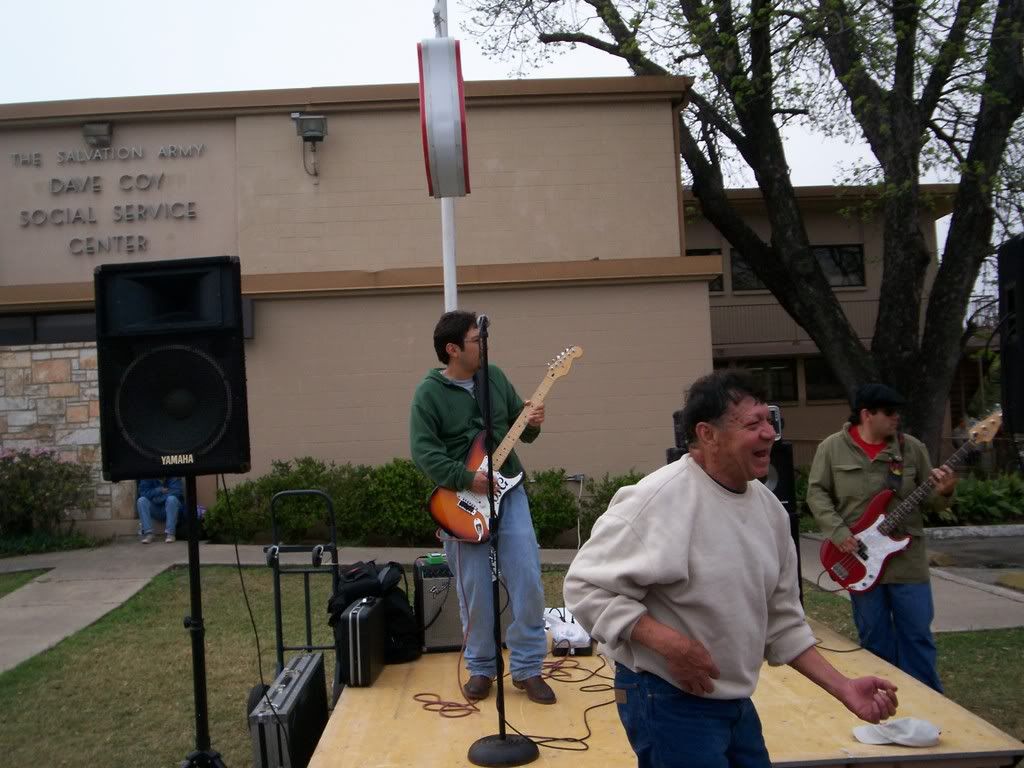 There was also the obligatory “crazy old man” dancing (beige shirt in front). This guy looked like he was having a good time and people had fun watching him. San Antonio may have a “crazy people dancing” syndrome but we rarely have “creepy crazy people dancing”.
After four years of participation, I think that there is only one major flaw with the “Race-for-the-Cure…..a lack of bathrooms along the race route. In fact, there are usually only two at a Shell station just past the two-mile mark: Check out that line. The starting/finish area has tons of porta-potties but the above are the only ones along the race route. Considering the walk takes a while, you better hope the downtown businesses are accommodating.
Next, was an even more pleasantly surprising entertainer. We heard her long before we saw her. From up the street came this “Bette Midler” sized voice singing Aretha Franklin’s “Respect”. All of our ears perked up because she was really belting it out! We were all prepared to be impressed. But when we rounded the corner, she was this tiny, little girl!! *was even more impressed than expected*: The singer is the girl in the green. Several race participants (pink shirts) decided to jump over and start dancing with her. See what I mean about “crazy people dancing”?! It’s like this weird group compulsion.
Unfortunately, this singer was followed by the most unpleasant experience of the race for me. There were protesters...With pictures that were extremely NOT appropriate for a family audience. I get that people could have legitimate issues with how the Susan G. Komen Foundation is run. However, there are more appropriate times and places for a protest. The race is about the survivors and the sick, about their families and friends showing their support, not about politics. I took pictures of these assholes but I’ve decided not to post them; they don’t deserve the free publicity.
Even with a slightly bigger group and some health issues, we managed to finish earlier than last year: In fact, this may be my best time yet for the 5K race. Perhaps due to my yoga classes?
As we walked back to our parking spot, my mother and I spotted some real honest-to-God celebrities (besides some NBA guy and all those newscasters at the beginning of the race). First, we caught Ronald McDonald attempting to flee the scene: This is as close as I was willing to get due to my latent fear of clowns.
Next, was local star, the H-E-Buddy! The race was worth it just for this brush with greatness. ;)
All in all, an excellent way to spend a Saturday morning.
Part 2: FOUND HERE – On San Antonio’s downtown buildings.
Sunday, March 30, 2008
CD Baby = Sonic Brilliance!
It all started with a music post over at Sepia Mutiny. After clicking several links, I ended up at music site CD Baby, which is an absolutely fantastic place to discover musicians you didn't know existed. I've spend the last two hours listening to and purchasing music there.
The best (IMHO):
Raghu Dixit's self-titled album - Give tracks 2, 5 and 7 a listen. This is the reason I found the site and was my first purchase.
Children of Agape - A deservedly sold-out album of Zulu tribal music and traditional spirituals. Gorgeous music from an orphanage's children's choir. I'm buying as soon as it's available.
"Blondfire" by My Someday - A wonderful britpop duo. "Oxygen" and "Lovesick" are particularly good tracks. I also bought this one.
"Unearthed" by E.S. Posthumus - Blending electronic, classical and world music, just a fantastic album of good, chilling music. Also purchased today.
"Huria" by Sanna Kurki-Suonio - Finnish folk music! Very sparse arrangements but excellent. I highly recommend the jazzy "Tytto Kulkija" and the very catchy "Matkalla".
(sigh) At the rate I'm going, my entire day will be spent with one ear on this website....
Friday, March 7, 2008
Correcting the Gaps – An Unusual POV
During the write-up for my review of Thomas Friedman’s “The World Is Flat”, I had the beginnings of an idea about how the developed world could address the Ambition/Education gaps between our youth and those of the developing world in order to stay competitive in the 21st century. This approach would not involve teaching so much as encouraging participation in the act of flattening by a larger segment of the population.
See full post for summary of the problem, a current social phenomena where people are teaching themselves all sorts of things and why it’s a very good thing.
Amercia’s education system is dated. We have a 20th century system that turns out 20th century caliber employees. Unfortunately, it isn’t the 20th century anymore. And a great many qualities of our education system are preventing us from graduating productive 21st century citizens. This is a huge problem that will take massive effort to correct because America’s education system is also heavily decentralized. For the most part, I would consider the decentralized aspect one of our education systems good points. It allows for experimentation and variety in education much like our federal system allows for the same in government. In addition, part of the problem is generational and cultural. We have a lot of older teachers who think in old ways. And until they change or retire, we’re stuck with a 20th century approach. Colleges have been slightly better at making this transition, mainly because they are more directly beholden to outside forces like employers and alumni. K-12 education, and especially 6-12, is however mired in out-of-date teaching methods, decaying infrastructure and lack of accountability. How we can change these things is unclear and will be a difficult, complicated endeavor. But in the meantime, American students are graduating without competitive skills for a global market. This is the Education Gap.
The Ambition Gap, as described in Friedman’s book, is the fact that American students aren’t as willing as Chinese and Indian to really apply themselves to learning and working hard. While this is partially a byproduct of a poor education system, this problem isn’t limited to students either. Long-time employees stagnate with dated skills and a false sense of entitlement that reduce their value and employability. But in the developing world, there is a real drive for constant self-improvement. This process of learning, unlearning and relearning results in a highly adaptable and versatile workforce. In the flat world Friedman describes, it is this workforce that will succeed. If our education system cannot provide such a workforce for the reasons described above, are there any other parts of our society that can provide this incentive to learn, reinvent and innovate?
I would propose that there is a significant mitigating force within our society (by “our” I include the entire developed world) which can buy us some time before there is a major crisis with our gaps in education and ambition. This will not however make up the generational numbers gap in technical professionals. Again, I don’t propose this is a cure-all but it could help some people until our institutions change.
First, let me begin with some examples:
a) Fic-a-thons & Peer Reviews
Every day, fans of various TV shows, movies and books issue challenges to each other in the form of prompts and fic/icon/vid-a-thons. There is a constant outflow of product from these activities from stories to graphics to videos to hand-crafted goods. Fic-a-thons in particular are interesting because they usually include a time limit as well as other constraints (like word count for a story) which challenge the fan-creators. In addition to these activities, everything is shared and peer-reviewed through comments on websites, linking and proof-reading (known as “beta-ing”) activities. Countless people are willingly exposing themselves to challenges and criticism by participating in these activities. In order to complete these challenges, fans must learn new facts and skills and apply them in an interesting or innovative manner. Success defined as producing something others enjoy and value. Think of it as “open-source” entertainment with some vigorous peer-review.
b) Sweet Charity & Others
A particular form of fic-a-thon or fan activity is the charity drive. This is an interesting twist on the fan-challenge. Here fan-creators put up for bid a product of their work, sometimes a specific format or topic and sometimes to be chosen by the winner. Other fans bid on the work in an auction and the winner “gets” the story/vid/whatever. In this manner, fans have raised tens of thousands of dollars for charities around the country (perhaps more – I’m just referring to the numbers I’m aware of through my own web-browsing). These charitable drives can sometimes bring attention to small, local charities that do not usually attract wide-spread support. For example, “Supernatural” fans have repeatedly raised money for a homeless shelter in Lawrence, Kansas, a town that features prominently in that TV series. Fans who organize these activities are gaining valuable experience coordinating activities across national borders, in various legal environments and with using web applications for publicity, money collection and distribution.
c) The Fans4Writers website & forum
Perhaps one of the most developed and “mature” form of fan activity is activism. Usually this is limited to keeping a show on the air (google “Jericho” and “peanuts”). However, in November of 2007, fans branched out into political activism with their enthusiastic and multi-pronged support of the WGA strike. One the first day of picketing, fans delivered food after gathering funds from international sources. On the second day, they created a food fund. Within a week, they had a website, list of projects, fan-forums (with writers for some shows dropping by). In particular, the fansite “Wheadonesque” should be noted for generating the idea and coordinating with its namesake Joss Whedon to ensure fan activities help the WGA to the most degree possible. In November of 2007, the latent talents of many fandoms in organizing, publicizing and generating content quickly were brought to the forefront and given purpose beyond entertainment. I expect as the flattening of the world progresses we can expect more "cross-over" activity of this nature.
As demonstrated by the above examples, you have a massive global collection of people all learning new skills, supporting one another and constantly engaged in generating productive content, activities and/or self-improvement. While engaging in discussing their fandoms, these people are forced to confront a multitude of opposing viewpoints, study/analyze them and form/defend their own opinions. What amazes me most about fandoms is that so few outsiders realize how much crossover fandom-acquired skills could have in the economic world. The skills developed by the above activities would be useful in any modern career. I would contend that in a flat world, an 18-yr old whose experienced in organizing charitable events, self-tutored in copyright law and capable of teaching themselves various software applications is a better prospective employee than a similar 18-yr old who works at your local McDonald’s.
I think too often when outsiders look at fandoms they see the sex, weirdness and bad grammar but they fail to see all the skills being utilized. Yes, there’s bad grammar but you also have teenagers writing, being exposed to peer review and criticism in a way some of our public schools no longer provide. Yes, there’s sex and weirdness BUT in order to document, share and develop these types of narratives, everyone involved has to learn web applications, publishing programs and graphics software. Not to mention that members of fandoms tend to inform themselves on topics like copyright law, financial law for charity creation/online banking and media-technologies because these are topics directly relevant to their activities.
In addition to helping people self-educate about various issues, participating in fandoms drags the “average” citizen of a country into the flattening world. Just like a multi-national corporation outsources to various countries for its components and services, so do fandoms outsource, in-source and perform all the flattening activities we usually associate with economic entities. A Canadian fanfiction writer with a weblog might have beta-readers in South Korea, Australia and the UK. They might use on their website graphics designed by persons in the US, Japan and Germany. They might be the beta-viewer for fanvidders in India, South Africa and Mexico. This means that a person who participates in online fandoms, whatever their other eccentricities, is directly a part of the flattening phenomena and intimately familiar with it. Again, if it could be translated to the professional world, this familiarity would be a huge asset.
Fandom represents one aspect of American culture that I believe Freidman doesn’t address in his book. One of the reasons for the high numbers of Chinese and Indian graduates is massive institutional support for their governments. And that’s a very good thing for them. BUT, American culture is slightly different in that very often our institutions are not the cutting edge of change. Since we’re such a historically open culture, very often change and self-development occur outside of institutional bounds and guidelines. I believe fandom is a classic aspect of this. It’s an unofficial, barely tolerated activity hundreds of thousands of people participate in but which is transformative, educating and highly optimized for success in a flat world. Some developing countries like China are just now learning about these kinds of activities and they are getting good at them. But, the US (and to some extent Western civilization as a whole) both have socio-political systems already optimized for grass-roots, distributed activities of this type.
As much as our education system needs updating, I don’t think the massive government-sponsored education overhaul outlined by Friedman is the best way to go for the US. It’s too much like trying to play at someone else’s game; a game that frankly China and India are in a better position culturally and politically to win. What America should do instead is learn how to play our type of game better. We should do everything we can to encourage distributed, self-educating, collaborative behaviors in our society. And there are a number of corrective actions which are not directly education-related. Institutional (socio-political) changes could include copyright and patent reform, improving broadband access, and immigration reform for legal technical professionals. Cultural reforms would not be so easy; by their nature, they are more subtle and less centrally determined. But this is where fandom-culture could really pay off. It already has a work ethic, self-improvement ethic, peer-review ethic and friendly competition ethic. And it is constantly innovating, providing those that participate with perhaps an improved ability to absorb, accept and adapt to change.
I do not advocate fandom participation as whole and complete solution. It is one approach in what will need to be a varied tool-box of solutions for adapting to a more global economy. The lack of math/science understanding of the architecture of a flattening world is what I believe the biggest barrier to fandom participation acting as a true mitigating force on the Education gap. Fandoms tend to focus more on skills than outright education. In my experiences, if there is an education focus, it is usually in softer topics like anthropology or languages. Thankfully, there are other forms of open-source education for instruction in math and science. Particular examples include The OpenScience Project and Instructables. Not to mention that more and more universities are following MIT's lead in placing lecture notes and course information online. These sites act as social networks for those who wish to teach themselves more about the technological underpinnings of the modern world. Using the very same skills of fandom (tagging, peer review, requests/prompts, organized activities), people can keep their skills fresh, expand their skills or learn something completely new. What fandom does isn’t provide math/science education. It instead provides its participants with a mindset of learning and innovation which can be easily transferred to more technical but equally distributed social networks.
Fandom culture has its flaws: the specific jargons, the clannish behavior, the inevitable explosions that occur when fans argue. These idiosyncrasies are fully translatable into professional culture. Of course, that translation would have to be carefully navigated. While transition from fan to professional is not uncommon in the entertainment industry, it is unheard of in other fields. I would be quite curious if there are former or current fans that have ever been offered employment based on skills they acquired from fandom participation. I would be especially curious for people outside of the entertainment industry. This would probably be the easiest way to verify my thoughts.
In the absence of an institutional shift to address for gaps in the quality and education of US employees, fandom participation has the potential to make up some of the differences in performance between developed countries and developing countries. In the process, it can imbue large segments of the developed world with a passion and ability to perform the life-long learning necessary for success in an ever-flattening and increasingly competitive world.
Sunday, March 2, 2008
“The World is Flat” by Thomas Friedman
As I read “The World is Flat”, I was overwhelmed by many conflicting thoughts. Each chapter markedly changed the review post I had begun to mentally compose. Each chapter resulted in a mish-mash of agreement, disagreement and unease. The short version of my review is READ THIS. The slightly longer version is this isn’t an easy book to read for an American especially but it is I think a thought-provoking, well-researched and well-presented book.
Full post has my thoughts on some of the book’s particular points....
I. The Causes of a Flat World and How We’re Not Ready for It
The first part of the book describes Friedman’s own realization that the world was flattening and what the ten causes of the flattening are. The interesting thing about these causes is how many of them are technology related. In fact the only one not technology-related is the first: the fall of the Berlin Wall and the openness that followed. The remaining flatteners include Netscape going public, the open-source movement, outsourcing/Y2K, supply-chaining and [self] informing through search engines. The author points out later in the book that not everyone is aware of this flattening and not everyone is/will be included in it.
He mentions the youth of America in particular by citing three barriers to American success in the 21st century flat world: the Numbers Gap, Ambition Gap and Education Gap. The first is the fact that a large portion of our most educational technical professionals are nearing retirement age and we don’t have enough new, younger professionals to replace them. The last two gaps are noted differences in how Chinese and Indian students look at the world versus how American students look at the world. Friedman refers to this as the “American Idol” problem. The fact that so few American youth seem to be capable of accurate self-assessment. They want the high-end jobs but they want it quick, in a contest or with a reality TV show prize. When combined with American feelings that because we’ve “always” been number one, we always will be, you get a dangerous sense of complacency.
I can definitely agree with these points for the simple reason that I’m a prime example of complacency. A year ago, I had a startling realization: I was in a rut. This is what led to my Personal Enrichment goals and to this weblog. I wish to be clear. A year ago, I possessed a good job I enjoyed, an apartment, a savings account and a retirement plan. By all measurables, I was comfortably middle-class with no worries. What was lacking was the PLAN. I had no personal goals for the next five years, no expectations for self-improvement outside of my work/financial responsibilities. I intend to work my hardest to ensure I don’t let myself fall into a rut like that ever again. The problem is that too few American workers or students realize they are in a rut or that it’s their job to get themselves out of it. And if we are going to compete with the Chinese and Indians successfully and collaboratively, more people need to have the realization I did and more people will need to do something about it.
I do have some contrasting thoughts on why the Ambition/Education gaps at least may not as big of a concern as Friedman supposes but they are beyond the scope of this book review. See This Post for exploration of those thoughts.
II. When Flatness Goes Astray
The remaining parts of the book detail the prospective future of a flattened world and what could threaten that future. From promoting corporate social responsibility to giving countries pause before initiating violent conflicts, the flattened world has a remarkable potential to change our world for the better. And not just change it but create opportunities for huge amounts of the world’s population to have real economic futures. When it comes to reducing poverty and promoting reform, few phenomena in the world today have the possible transformative power as the flattening world.
One point of credit to Mr. Friedman is that for all his hyping and positive outlook on the consequences of a flat world, he doesn’t shirk from the consequences of incomplete flatness, dangers to flatness and problems transitioning to a flat world. From the book:“There is absolutely no guarantee that everyone will use these new technologies, or the triple convergence, for the benefit of themselves, their countries, or humanity. These are just technologies. Using them does not make you modern, smart, moral, wise, fair or decent.”
He discusses several ways flatness could go astray, all valid concerns: Backlash by those left behind in the unflat world, terrorism due to the Muslim world’s inability to adapt, the curse of oil, the environmental problem of another 3 billion people living at Western levels of consumption. These are not small or easily solved problems. The book carefully outlines each one, its causes and possible solutions.
One particular worry he had was that when Americans realize that we are unable to compete in a flat world, we could return to protectionism and permanently hurt our economy and place of prestige in the world. In a flat, interconnected world, protectionism is suicide. Recently, this fear has borne fruit with certain presidential candidates advocating the US abandon NAFTA. They told this to economically beleaguered Ohio. You know, there is a real difference between leadership and pandering. Guess which applies here. In what way does abandoning NAFTA help Ohioans better compete in a flat world? It DOESN’T. It shelters them not just from the effects of international competition but from their ability to assess their value in the global market. By abandoning NAFTA, we would be telling the world that the US is for free trade until it makes us look bad, until it requires we change. We wouldn’t be helping Ohioans or Americans. True leadership would be to help Ohioans compete in a flat, open world. True leadership would be to offer job retraining, education incentives for older students, and initiatives to spur small business development. True leadership would tell Ohioans, “The world has changed and that is scary. But please understand, this change isn’t going to be undone. However, I believe that Ohioans can take control of this change and benefit from it immensely. But we don’t expect you to do it alone. My job is to make this change bearable. To ensure you have the tools to take full advantage of the new opportunities.” Unfortunately, America’s current political class is more likely to pander than lead.
There is also a scathing section on the flaws of the anti-globalization movement or as he refers to it, “Keeping Poor People Poor”. He outlines the constituents of the movement and their flaws. But he also goes to great pains to state that valid criticism of how we globalize is 100% critical:“What the world doesn’t need now is for the anti-globalization movement to go away. We just need it to grow up....You don’t help the world’s poor by dressing up in a turtle outfit and throwing a stone through McDonald’s window. You help them by getting them the tools and institutions to help themselves. It may not be as sexy as protesting against world leaders in the streets of Washington and Genoa, and getting lots of attention on CNN, but it is a lot more important. Just ask any Indian villager.”
On the issue of terrorism and the Bush presidency, Friedman and I have some very different opinions. He appears to have an excellent grasp of the Arab-Muslim mindset that leads to terrorism and ways we can count that mindset through positive developments like promoting Arab-owned businesses and innovation. However, he completely ignores the military aspect of the problem. Indeed, I don’t think he considers there to be a military aspect to the problem.
Please understand, I don’t think bombing countries into submission will fix terrorism. What the military option does is act as a stop-gap, protecting the flat world until the Arab-Muslim world can be reformed. This will take a couple of generations and involve many types of approaches to different aspects of the problem. A terrorist, someone who has spent months or years planning to destroy human life, is not going to reasoned with at an international conference. That person you have to kill or convince. Convincing is unlikely to work but occasionally you give it a shot and the goal is to get better at convincing as time goes on. But first, you’ve got to clear the field of the die-hards. To me, that’s what Iraq and Afghanistan have been about. Using overwhelming force, what the terrorists and their advocates understand, to get those that can stop and think to stop and think. And to kill those that can’t be stopped otherwise. If you first clear the field of the die-hards and scare some into not being die-hards anymore, then perhaps you can get people’s attention long enough to notice there’s elections and parliamentary reform and quit writing off the Muslim world as the one billion person segment of humanity for whom democracy just doesn’t work. Create examples of forcible reform to demonstrate to those passively supporting terrorism that there are other ways to address their grievances. These are the first steps necessary required to get to the wider steps Friedman describes. I agree with most of his proposals but I consider them Anti-terrorism 2.0 not 1.0.
III. Conclusions
All in all, “The World is Flat” is a hugely interesting read. It’s just not a comforting one. Some assumptions about the world are validated and others rendered moot or ridiculous. But I do believe the book describes a real phenomenon that has the potential to greatly improve the world. It remains to be seen whether we will accept and adapt to the full potential of a flat world. In conclusion, here’s a particularly apt quote from Michael Mandelbaum:
“People don’t change when you tell them there is a better option. They change when they conclude that they have no other option.” – quoted in the book
Thursday, February 7, 2008
Parabolas & Culture
Ok, this thing is huge....Don't click the link to the full post unless you really, really, really mean it.
After reviewing “The Archimedes Codex” recently, I got to thinking more about how Greek mathematics differed from our own system. Specifically, I wondered about the capabilities of the two systems and how it affected certain types of calculations. Full post compares modern methods with "the Greek way", specifically for various areas under and inside parabolas.....
Warning! Full post contains mathematics (mainly calculus with a little bit of geometry)
Warning2! I am NOT an expert in Ancient Greek society or mathematics. I make many generalizations about both. I could be wrong....
Archimedes developed this geometric derivation of the area of a parabola (starts on pg10 of the pdf). The use of geometry is unsurprising as most Greek mathematics favored geometry. Not to mention, for this proof Archimedes made large use of the lever principle (which he developed) and balancing of a triangle (which he also developed)....This is known as playing to ones’ strengths.
But I think it’s interesting to compare this method with how we would make the same exact calculation. Here’s my calculation of the area of a “basic” parabola:
There are several features to note about this calculation. Unlike Archimedes, our system describes the parabola with an equation not an arc (ABC). We go to great trouble to place the parabola in the correct location in space (“space” described by another modern concept, the Cartesian coordinate system). Greeks were also concerned about location but mainly in relation to shapes inscribed or circumscribed by the parabola in question. These relationships usually provided them with the identities and equivalences that allowed for complicated derivations. Also, look at the number of abstract concepts & symbols involved in the modern calculation which you have to understand in order to follow the solution: the integral sign, the equation and several theorems involving using substitutions to solve the integral.
Even though the system is very different from his method, this does correspond to Archimedes solution. 
Where things begin to get interesting is when you consider the area underneath a parabola curve. There are a number of real-world problems involving these type of solution in physics but they were unheard of in Archimedes’ time.
First let’s look at how we would solve this problem:
It’s not too different from the first solution is it? And the solution is pretty easy to verify:
For both the area under the curve and the area inside the curve, we use Archimedes solution to check our own. In his day, these solutions were cutting edge thought. After two thousand years, we take them as bald facts whose origin is of no more interest to most students than the secret history of 2+2=4.
But what happens when we only want to calculate the area of a small slice underneath the parabola? For the modern system, it’s not too different than our other solutions: 
However, I have no idea how or even if Archimedes would have calculated this. I attempted to recreate his parabola area figure and modified it as I felt appropriate for calculating a slice: 
The problem with attempting to solve this geometrically is that there are too many variables and no clear way to relate them to each other. When looking at the curve as a whole, it’s easy to develop proportions to use in eliminating some variables. When looking for the area of a small slice, those proportions are no longer true. The relationship between what’s inside the parabola and what’s outside it changes depending on which slice you take. For instance:
There are a couple of reasons why I don’t think Archimedes or any Greek mathematician would have ever performed this calculation.
Mainly, this calculation involves ugly proportions and the Greek placed real value on “beautiful” relationships between numbers. Hence, they developed ideas such as “The Golden Spiral” and "The Golden Ratio". In general, the Greeks weren't interested in randomly-sized bits of things. They could and did manipulate proportionate pieces of whole objects. And based on Archimedes geometric calculation of the area of a parabola, they had no problem using small-bits of shapes as long as they were used to derive relationships between whole shapes. A random bit by itself had no interest.
Also, the Greeks had a much higher expectation of order in things than we do. In modern times, developments like Thermodynamics, Quantum Mechanics and Chaos Mathematics have led to a much less cultural expectation of order in the Universe (or at least much less expectation of "simple" order). Therefore, to the Greeks, to expect random slices of things to have any real-world meaning would be a little bit nuts.
I can’t even imagine a Greek mathematician sending this problem out as unsolvable. While Archimedes apparently liked to tease his competitors/colleagues, he thrived on his reputation as a master. I don’t really see him or any Greek mathematician sending a problem out stating “I couldn’t solve this” even if it was also to say “Here’s a frustrating little riddle that should keep your chickpea-sized intellect busy for a while”. Not to mention that Greek mathematicians were usually subsidized by rulers who kept them around because they could solve problems. If word got out they were stumped, it might hurt not just their prestige but their livelihoods. In Archimedes’ case, his patron was possibly his relative, Heiro II of Syracuse who made active use of Archimedes’ reputation for both military and diplomatic purposes. I don’t see any such ruler as being understanding about a drop in that reputation.
Still, before reading “The Archimedes Codex” most experts on Greek mathematics would have said Greeks also stayed away from infinities because they didn’t conform to their ideas about how numbers should work. We now know this to be untrue. It’s possible they tried other things as well and records of those calculations didn’t survive into the modern era.
If someone back then did give these bounded problems a shot, I would expect they focused on special cases which happen to have proportional relationships to the whole curve solution in order to get the variables to work out right. Also, if they sent it out to other mathematicians, I could see someone like Archimedes, knowing damn well their solution is special-case, saying “I leave the calculation of similar slices as an exercise for you.” This would allow them to present their solution (and intellect) while also teasing their competitors with a problem they would find exceedingly frustrating.
A slightly tangential point: Doesn’t the modern way strike you as almost terse and quite dense compared to the Greek methods? Their ways involve much more flourish and explicit delineation of concepts. The latter partly because they were the first to develop certain concepts so they had to explicitly delineate them. Our way really reflects our societies values of efficiency and “getting as much bang for your buck”. Each symbol represents not just itself but a whole body of thought. Each manipulation of those symbols portrays the results of hundreds of years of mathematical development.
This reminds me of a comment one of my English teachers once made that “poetry was compressed speech” where one word represented dozens so that the information provided in a poem was much larger than you would expect based on a word count. If this is true for words, I would expect it’s true of mathematics as well. It functions as a form of symbolic poetry where each symbol can express many things simultaneously. This has nothing to do with Greek mathematics specifically; I just think it’s cool.
Friday, November 30, 2007
*Is Impressed* Eon MC
Whoa. Via Smallest Minority, I was reading the commentary here. There's a lot of talk about blaming hip-hop music for the state of the black community. BUT there's also talk about blaming a lack of parenting. It's kinda a "Which came first?" argument to me. However, I'm a white woman from the Houston suburbs so what do I know, right? Anyway, someone linked this artist's MySpace.....
WOW. I've never been a huge fan of hip-hop or rap. I believe it can be a really interesting and exciting form of music because when certain artists have stopped singing about beating women and killing each other, their work can be really, really good. Unfortunately, those instances are few and far between. This artist, Eon MC, he is a revelation.
From "Chip on My Shoulder" to "Under Pressure", his lyrics are just wonderful. Please go and listen...
Thursday, November 29, 2007
Talent vs. Effort in Education
Scientific American has an absolutely fascinating article up about the differences between kids who succeed at school versus kids who fail. Their reasoning is summarized in this quote:
Praising children’s innate abilities, as Jonathan’s parents did, reinforces this mind-set, which can also prevent young athletes or people in the workforce and even marriages from living up to their potential. On the other hand, our studies show that teaching people to have a “growth mind-set,” which encourages a focus on effort rather than on intelligence or talent, helps make them into high achievers in school and in life.Over the years, I've seen many tech-bloggers state that upcoming developments in genetic engineering will make it easier for parent to design smarter, better behaved children. But, what if that isn't enough? If a parent specifically planned for a kid to be smart, which do you think they are more likely to say to their child? "You are very talented/special." or "You worked hard."?
Not to mention, these results sync quite well with my own experiences. My default mind-set is unfortunately in the “innate talent” category. At one point in high school, I actually tried to convince my parents to move me to a lower level “Algebra II” class. I was barely passing the honors level class and actually told them “only stupid people had to study”. Thankfully, my parents didn’t listen. They instead grounded me until my grades improved.
Even today, I’m not a self-starter in the traditional sense. I can make myself start but it requires very conscious effort. If I quit that effort, I quickly slide into a rut. That’s one of the reasons why I created my Personal Enrichment Goals at the beginning of 2007. I realized that I had created for myself a very narrowly-defined comfort zone. The PE goals were about challenging myself in ways that will help be able to accomplish my long-term goals.
Right now, I’m in the process of writing my Personal Enrichment Goals for 2008. These goals are much more demanding than the 2007 list. But this year was a trial run, proving to myself I could do more and enjoy it. My experiences with installing and learning Ubuntu are a prime example of that. Next year’s list is about really challenging myself. Hopefully, in time I can train myself to have more of a growth-mindset. Link to full post.
Friday, November 16, 2007
Friday Miscellany
I missed this earlier in the week due to illness so here ya go...
1) Testing new rockets. It really seems like the next 5-10 years will see some wonderful experimentation in different types of rocket engines and spaceship configurations.
2) Why Congress Just Cannot Be Trusted! Apparently, they are more concerned with doing the entertainment industry’s dirty work than educating American students. PUNKS.
3) Go watch this...Kurt Loder participates in a conversation and Q&A on technology and freedom. Very interesting. He does appear to have his ear on the ground for rampant nanny-statism. Best line: “It’s ridiculous for a band to say 'We're going to change the world' or ‘Down with the MAN!” and they're working for Time-Warner.”
4) I do not often use this word on my blog but I feel the article warrants it. FUCKING SAUDIS.
Sunday, November 11, 2007
YouTube on The Writer's Strike
Now, there is of course the OFFICIAL WGA YouTube channel. While that's good, there's commentary from all corners being posted. In 1988 the best the average TV fan could hope for was being interviewed on local news. Nowadays, they have other options.
See full post for some truly amusing commentary on the Writer's Strike. (Lots of embedded videos)
First "Ask A Ninja" Speaks out:
The Very Official AMPTP Position
Evil Mickey Mouse Supports the AMPTP
The Guys from Zoomilk
Some good criticism of both sides
Tuesday, November 6, 2007
TED Talk by Larry Lessig
Once again, the TED talks provide an opportunity for a great thinker to spread their ideas. In addition, I want to know where he found his example videos....Larry Lessig on the Read-Write Culture (I tried to embed the videos but it gave me errors...sorry).
PS - This is what the third TED lecture I've linked? If you're not checking out these talks, I think you're missing out on the cutting edge of modern thought.
Thursday, October 25, 2007
First Lady in UAE
This photo says just about everything I need to know about the place of women in Western versus Arabic societies. Via JammieWearingFool.
Link to full post.Monday, October 8, 2007
Monday Links-Of-Wonder!
Disclaimer: This post was generated while listening to The Cult's “High Octane Cult”. I have no idea what it's done to me.
1) Lost Archimedes Works Found In Re-Used Pages of Medieval Prayer Book. AND these recovered works hint that Archimedes was laying the early groundwork for calculus. And by early, I mean, 2000 years early! There's a book out Nov 1st called “The Archimedes Codex” which describes both the effort to recover the texts and the mathematical importance of what was found. I'm definitely adding it to my “To-Read” list. Fascinating.
2) Using LOL Cat Posters to reveal Deep Secrets. I don't know what to think of this. The Internet does some strange things to social interaction doesn't it? Few of these are funny. Most are quite sad. I guess it's good these people have some way to vent.
3) Underwater Robots “Buzzed” By Sperm Whales. Part One. Part Two. Apparently Sperm whales have been getting a bit curious about all these mechanical interlopers.
4) The 9 Manliest Names in the World. What makes it comedy gold is that they placed a founder of Quantum Physics and a NASA scientist on a list that includes Magnus ver Magnusson. Also, there's someone in the US Navy named COMMANDER FLEX PLEXICO! I love my country.
Subscribe to:
Posts (Atom)

 Posts


