Showing posts with label computers. Show all posts

Monday, November 7, 2011

SOPA: Enabling & Facilitating The Death Of Internet Innovation

WARNING! After not posting in forever & a day, I'm breaking my dry spell with a mega-post. Double-warning - no cut-tag on this one. I may only get a hundred or so people a week but you are should be aware of what Congress is up to.

Many people have dissected the proposed SOPA bill before the US House of Representatives Judiciary Committee. I am not here to rehash all of those arguments as others have made compelling cases regarding the problems with this bill. Today, I am going to explain what I find to be the worst portion of the bill, and why that portion is a fundamental danger to the internet and our future as an innovative society. There is a phrasing in this law which potentially endangers the entire Internet: every site, every domain, every single aspect up to and including the US government’s own websites. Several articles I read mentioned that this phrasing is a concern but to me, it is the most broad and most dangerous portion of the proposed bill.

People may find it ridiculous that I'm getting worked up about three little words but court rulings have been decided based upon slight turns of phrase buried in the text of a law. The fact that everyone supporting this bill believes their own web presence exempt from this clause reflects a nauseating hubris resulting from a combination of entitlement, technological or economic ignorance and knowing corruption of our legal system.

Let’s get to the clause in question. I’m going to include the preliminary stuff to give you some context but the key phrase will be bolded.

“(a) DEFINITIONS.-In this section:
(1) DEDICATED TO THEFT OF U.S. PROPERTY.-An “Internet site is dedicated to theft of U.S. property” if –
(A) it is an Internet site, or a portion thereof, that is a U.S.-directed site and is used by users within the United States; and
(B) either-
(i) the U.S.-directed site is primarily designed or operated for the purpose of, has only limited purpose or use other than, or is marketed by its operator or another acting in concert with that operator for use in, offering goods or services in a manner that engages in, enables, or facilitates-“(1)
The text goes on to list various violations of trade-mark and copyright laws. Now, if you do not know anything about either IP or information technologies this may seem sensible. But this phrasing is the exact opposite of sensible because it ignores two key facts.

One, all intellectual property is information. IP is a legally recognized monopoly on segments of information consisting of either designs (encoded as CAD, drawings, etc) cultural artifacts (encoded as songs, pictures, videos), processes (encoded as services optimized for most-useful function) or objects (encoded as physical goods). So any law regulating IP is ultimately about regulating who gets to control what information and who gets to replicate or make profitable use of that information. This post is not arguing against doing this.

Secondly, all information technologies, the best known and largest being the Internet, are by design and intent about the sharing, copying and distribution of information. The initial purpose of networking was to communicate with and share computer resources among mainly scientific users at the connected institutions. This information-sharing default is not a historical factoid with no relevance today. For a number of the sponsors of this bill advertise their IT products or advocate other IT products which also help people share information. For example:

A number of this bill's sponsors share their IP via Hulu. From Hulu’s website:
Mission
Hulu's mission is to help people find and enjoy the world's premium video content when, where and how they want it. As we pursue this mission, we aspire to create a service that users, advertisers and content owners unabashedly love.(2)
The entire purpose of Hulu is to make information protected under IP laws available to the public. It exists to share information of a cultural nature.

Circling this square of two contradictory facts, and ultimately two fundamentally different economic models, will be a very important political and economic adaptation in the twenty-first century. Especially since information is neither industry-specific nor commercially-specific. We tend to be aware of information-proliferation effects on the entertainment industry but that is because its profits are the most dependent on perceived information-scarcity. However, every single business on the entire planet is affected by information technologies. Also important, every single cultural and political sphere is equally affected because all social networks are ultimately, information networks. This is exactly why information technology is quite so transformative and why it is also quite so destabilizing. Again, getting this balance between tolerating the old until we can transition to the new (or determining if we do not want to transition particularly valued portions of the old) is pretty much the Great Big Deal of our times.

So, we have this ongoing question of how to balance between two seemingly contradictory industry structures. Into this debate, our lawmakers have given us SOPA with its "enables or facilitates" criteria for illegality. This annihilates a balanced approach to our two contradictory structures. Again, every single information-sharing technology ever meets the criteria of “enables or facilitates”. EVERY ONE. Every webpage, every domain, every database, every peer-to-peer network, all of it regardless of the amount of actual infringing being performed on or using these tools. Every single one of those companies listed as sponsors is also a violator of this standard because every single one enables or facilitates information exchange via information technologies cited in this law. And if you enable or facilitate exchange of information, then it becomes possible to exchange (legally or not) IP which is nothing more than a protected category of information. This bill does not provide IP owners the ability to destroy those who violate IP law; SOPA gives whomsoever can afford legal counsel the opportunity to destroy websites based upon the physical possibility of IP infringement absent any other proof of wrongdoing. This would cover every single site on the entire Internet.

I know what supporters of this bill will say, “But that’s ridiculous! We only mean sites which break the law!” But, and this is important, that is NOT what the law actually states. “Enables, or facilitates” does not require that IP laws are broken only that the violation of the laws cited is enabled or facilitated. Again, all web sites, by inherent definition and function, including those of the bill’s sponsors, meet this standard.

Wait a minute! I’m ignoring something. Elsewhere in Sec.104 of SOPA we find that in order to get these take-down injunctions the submitter must include:
“...under penalty of perjury, that the signatory is authorized to act on behalf of the holder of the intellectual property right harmed by activities described in subsection (a)(1)” (3)
Well, that solves everything, right? Because copyright holders never submitted frivolous or wrong-headed take-down notices. Being major corporations, they would not be terribly burdened by the occasional court costs imposed for being a little too aggressive. Especially compared to IT start-ups or mom-and-pop business who can't blow money on litigation with no revenue coming in without ending up in bankruptcy court. Also, RIGHTHAVEN. A company proved NOT to own the copyrights in question managed to shake-down dozens of people for who knows how much money before getting caught. How much worse would it have been if RightHaven could have brought whole sites down first? How many small business owners could be extorted before they were caught?

Nothing in the this clause actually delimits the “enables or facilitates” to portions of sites or users of sites actually violating the IP laws cited. Someone, who is a legitimate IP representative, could file these injunctions against a site not for violating their IP law but for “enabling or facilitating” a violation of their IP law. This is the key. You do not have to actually commit IP infringement to get these injunctions placed upon you. And anyone who makes an argument about judges not allowing frivolous injunctions – how are they to determine the facts when they only have the plaintiff’s accusations to go on? An injunction is issued prior to the defendant being told about it not after you have had the opportunity to contest the claim and failed.

Now, supporters of this bill all claim that this level of regulation is necessary to stop “real companies [from] being bled to death by these foreign IP-thieves” (note the hand-waving over the fact this bill also regulates domestic sites). This would be significantly more believable if these same bill sponsors hadn't just issued the “Copyright Industries In The US Economy” Report which basically says theses same poor, put upon industries are somehow, despite being threatened by every website ever, making absolutely bagfuls of money. All that profit does not exactly justify broad extrajudicial powers to protect these guys. If they are doing fine, why do they need this law? Especially since content-sharing industries based on IP-law exceptions are actually a pretty significant boom to our economy as well.

The problem is that none of these pro-SOPA folks are honestly dealing with the elephant in the room: A great many business-models are based around the scarcity of information in time and space. No industry more so than entertainment. So, you have a global information network which eliminates the scarcity all of these businesses are based on and, surprise! They want to control it. Of course they do. Control = Forced Scarcity. With this control, their business model survives and so do they.

More importantly, this level of control means that anyone who wants to do business on the internet has to go through them, the self-selected gate-keepers, first. Innovators have to make “gentleman’s agreements” with this protection racket in order not to be threatened by these take-downs. These same innovators will be forced to make these deals from a negotiating position of extreme and government-enforced weakness. Anyone who attempts to threaten an information-scarce-based organization, political or commercial, without breaking the IP laws cited does not get to compete fairly against these scarcity-based models because whomsoever is most threatened by a legal information-proliferating competitor can file a take-down injunction against them under the “enables, or facilitates” criteria. Anyone who denies this possibility simply has not been paying attention to how IP law actually operates in our courts.

If a patent or copyright troll can hack existing law to extort people for money, what do you think they will do with an opening like this one? One which does not require the breaking of IP laws, but only the possibility that such violations could occur.

This is of course, a ridiculously broad criteria. And the second you start applying it elsewhere, that becomes very clear. For example, it is physically possible for me to run over people with my car. Doing so is rightfully illegal and morally wrong. However, I am not required, every time I purchase or use a car, to swear under penalty of perjury that I will not do this. Pedestrians cannot sue me based on the physical possibility of me injuring them with my vehicle, only if I do in fact injure them. The current text of SOPA, via “enables or facilitates”, is not so restrained. This broadness is exactly what all information-scarcity based organizations want. The broader the criteria of control, the better they will be able to control the marketplace rather than compete within the marketplace.

What is most face-palm-inducing about this is how little any of these organizations, companies or even the government itself realize that this law threatens them. Any portion of the web meets these criteria, including the parts SOPA's sponsors currently own or control. Each and every one of them are equally bound by “enables, or facilitates.” The difference is organizations like the MPAA operate under the principle that “he who has the best lawyers, wins.” They pay big money to have the best lawyers (and the best members of Congress). So, in creating this law as it is written, Rep. Smith, far from promoting “prosperity, creativity, entrepreneurship, and innovation”, is more accurately promoting “rent-seeking, extortion, litigious behavior and stagnant economic growth due to technology innovation slowdown”.

In some respects, I almost hope this law passes as is. Because I would pay for tickets to a trial some of these companies when it comes the IP battles that they start and fight with each other all the freaking time. Do they really think that their constant on-going IP suits against each other won’t extend to this law? Do they really trust each other not to use every legal tool available to win these lawsuits?

Which is another horrible future allowed by this law: One of IP trade-wars where companies, who routinely sue each other for patent or copyright infringement, now have a new tool in their legal arsenal to go after each other. While this would be amusing to watch, the legal costs of fighting these battles would likely be passed along to consumers or taxpayers. Additionally, site-shutdowns would endanger anyone whose livelihoods depend on websites, ads on websites and/or online payment providers. All that is right there in the text of “enables or facilitates”. All that is being pointedly ignored by these trade organizations because all of them believe that “enables or facilitates” ultimately, does not apply to them.

This hand-waving over “enables or facilitates” and insistence that, no matter the actual text of the law, it won’t be abused is why I am completely furious to share a state with Rep. Smith. Because you are giving today’s industries veto-power over tomorrow’s industries. You will not continue on the internet unless you get permission to exist first from some vested interest and your continued survival will entirely depend on cultivating that toleration. Again, I don’t give a damn about what anyone of the writers or sponsors of the bill intend. Laws and litigation are not often about intention; they are about what the text of the law actually says and allows. And, for SOPA the text of states “enables or facilitates” IP infringement NOT “actually commits or advocates the commission of the IP crimes listed below”.

Doubly ridiculous is how this bills’ supporters in Congress are being disingenuous about the scope of this law in regards to politics, elections and free speech. Because this same standard applies to government and political websites. The Department of Homeland Security recently got caught using a PSA video for which they likely did not have the appropriate copyright licensing. Members of Congress routinely use copyrighted materials in crafting campaign or position advocacy videos. Again, copyright law is very complex. It is easy to make a innocent misstep, especially if you’re a campaign staffer who does not specialize in IP issues. Do members of Congress really want to run the risk of accidentally having a copyright violation and, in the middle of an election campaign, having their websites and web-based campaign finance machine shut-down?

Again, each and every one of them is either ignorant of this possibility or thinks themselves above it. Now, D/R Establishment politicians would probably have a vested interest in not using this law against each other and they possess the lobbyist connections or experience to prevent this. But what about political outsiders like Tea-Party primary challengers or the Green Party or third party candidates in general? Establishment politicians see these kind of challenges as threats to their power base. This law empowers Establishment-supporting IP-holders with a rather specific tool to take down amateurs in the political arena, again because the criteria are so broad that it is not a question of who is violating IP law, but rather of, who doesn’t have the resources to stop us from litigating them out of existence? Who does “enables or facilitates” empower and who does it burden?

Now, again, I’ll probably get a lot of song-and-dance about IP infringers and darknets. If this law actually targeted those sites and people who actually break IP laws, then I would have no problem with it. Frankly, including commercial aspects of a web-site in take-down is a smart improvement for combating actual rogue sites and actual rogue users of popular sites. If the law targeted these people and only these people, then I would not be writing this post. But, “enables or facilitates” is such a gaping-wide criteria that the entire IT industry is under the gun. Again, this is not hyperbole because:

IP = Information (valuable because scarce or difficult to apply in valuable manner)

IT=Information-proliferating (reduces economic and political value of scarce information by making it common and easily shared/implemented but information also gains value due to network effects, commercial or social)

SOPA encodes into law is not a “targeted killing” of IP-infringers or IP-infringing websites but rather an ongoing threat of nuclear bombardment regardless of actual, provable wrong-doing in the hands of people who routinely sue grandmothers and get caught abusing the existing DMCA take-downs process (for example).

The important thing for the average citizen to understand is that none of these sponsors, political or commercial, has any incentive to interpret “enables or facilitates” narrowly. Information-proliferating technologies undermine entire industries on a structural level. These sponsors are big, unwieldy organizations and the people who benefit from their financing, all of which are at risk in the changing marketplace of default information-proliferation. This law means they don’t have to bother with adapting to these changes anymore. “Enables or facilitates” encodes into law “some (industries/politicians) are more equal than others” by empowering vested interests. “Enables or facilitates” takes the decision of who succeeds in this brave, new world out of the hands of the market and the consumer. It then places the IT marketplace, and all that transformative possibility, in the hands of lawyers and anyone with the deep pockets to pay them.

Now, you may think this overhanging threat is a good thing because it will keep people in line. People won't pirate when they could lose whole sites. But again, “enables or facilitates” does not threaten only those who violate IP law; it threatens everyone who is physically capable of violating IP law which in an Internet connected world is EVERYONE. This is because every single webpage, server, social network, peer-to-peer file sharer, campaign website, advocacy group, industry website, EVERY SINGLE ONE is designed to "enable or facilitate" the exchange of information. And again, all intellectual property is ultimately information. If you enable or facilitates the sharing of information then by design you are enabling or facilitating the sharing of intellectual property.

That’s the true extent of “enables or facilitates.” That’s the terrifying breadth of this law and ultimately, I fear, that is exactly what the industry supporters want. Because nothing terrifies any corporation more than being outmaneuvered by the marketplace. A lot of these bills sponsors feel out of control in an interconnected world. This is not an irrational fear nor should we dismiss it entirely. These companies have thus far succeeded in providing what people are willing to pay for. But the marketplace is an tempestuous, ever-changing mistress. Businesses come and go all the time. This is a reality that every business must deal with. These sponsors have been caught flat-footed by technology developments before and do not want it to happen again.

However, in a free market system, creative destruction is a fact of life. Of course, arguments could be made that we do not truly have a market-system anymore. Obviously, when the government intervenes in the banking, automotive and aviation industries in order to pick who survives and who doesn’t, then clearly, the market is being manipulated. As it is currently written, SOPA becomes just one more example of these sort of interventions. “Enables or facilitates” is exactly the tool by which the marketplace for ideas or money could be short-circuited. “Enables or facilitates” ultimately means that whether in politics or business, you either are deemed non-threatening to vested interests and are left alone OR you are labeled a threat and because of “enables or facilitates” vested interests can use their legal and institutional clout to make you disappear instead of having to compete with you.

If Congress wants to protect intellectual property, that’s great. This transition from information-scarcity to information-proliferation does not have to be dangerously disruptive. Striking a good balance between intellectual property and information technologies is a smart way to improve both old and new alike. So, how about Congress write a law that actually does strike that balance? That actually treats intellectual property holders and innovative technology companies like they are equal partners in creating a profitable, diverse marketplace of ideas and money? Because, as it is written, SOPA is not balanced or really even about protecting intellectual property. The actual text of SOPA is about giving legacy industries veto power of how the Internet should be used and how it should develop far, far beyond protecting their intellectual property.

Notes:
(1) Found in Section 104 of the bill. This phrasing is repeated in a similar form in Sec.103(a)(2) for foreign-based web sites as well (keyword “facilitates”). Meaning the U.S. Congress is applying the standard everywhere.

(2) How does this “enable or facilitate” IP infringement? Streaming videos on the internet can be retrieved from sites like Hulu in a number of ways. Hypothetically, let us say that an IP holder licensed their material to be shared via Hulu and later discovered users had stolen it provably from Hulu. If they believed that Hulu did not do everything the IP holder considered technically necessary to protect their IP, they could conceivably sue Hulu under “enables or facilitates” clause. Because Hulu is about, well, sharing videos Hulu would bear a high burden of proof regarding how they could be expected to both share videos and prevent the sharing of videos. That's how insanely crazy broad the "enables or facilitates" standard is.

(3) SOPA, Section 104(b)(4)(A)(vii)

Link to full post.

Tuesday, January 27, 2009

Warner Music Is On CRACK

Because when the Monty Python guys possess MORE sense than you regarding YouTube videos and copyright, then, I’m sorry Warner Music but you fail at life! How utterly delusional do you have to be to think you’re losing money because people are posting home-made dance videos using your songs! Again, when the Monty Python guys are out-thinking you all the way to the bank, besides functioning as a warning to others, what exactly is your value-added to the corporate world?

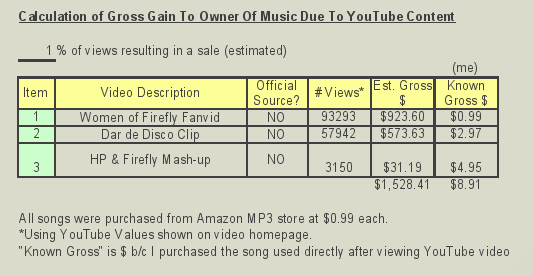
Do you have any idea how many songs I’ve purchased because I first heard them on video on YouTube?! Here’s three real-life examples:

Fanvid – Women of Firefly (using Wicked’s “Defying Gravity”)

Loved Firefly but, in addition to the craftsmanship of the fanvid, I really enjoyed the lyrics to this song. Snatched this one from the Amazon MP3 store the second I found a version by Idina Menzel.

Bollywood Video (Dar-de-disco)

Spent a weekend a couple months back just watching semi-random clips of Bollywood dance numbers on YouTube. I wrote down several songs but not all were available in the Amazon MP3 store..This one and a couple others were.

HP-Firefly Mash-up Video

Really enjoyable combo of fandoms but this video is how I discovered the awesomeness of Jonathon Coulton. Total songs bought after this vid: 5 that day.

Now, the next bit requires a bit of a leap but work with me: Imagine I’m not the only one who bought these songs after seeing these videos. Each video has a relatively large number of viewings....Let’s assume approximately 1% of those total view(er)s actually did what I did and bought the song, just the song, in the video. The below table shows that in each case, whoever owned these songs MADE MONEY because of these YouTube videos.

Other notes of importance:
(1) The videos themselves were all “unofficial” content, no one affiliated with the content owners had anything to do with creating or posting these videos.
(2) Even if my estimate of which % of viewers actually bought the songs is in question, I know that I bought every song cited (and then some) resulting total actual verifiable gross (spread to all content owners) of $8.91 MIN.
(3) While I cannot speak for any other viewers, for all of these songs, this money is a clear gain because until I watched these videos either did not know these bands or singers existed, much less that these particular songs existed, much less that I liked these songs. What these YouTube videos provided to me wasn’t a source of illegal content; what they provided was a previously missing desire to purchase these songs. If these YouTube videos did not exist, the content owners of these songs would have made $0.

Please also note, this same logic applies to books, television shows and movies for any fan-created or posted work. Again, some real-world-actually-happened-to-me examples are:

Purchasing “North & South” DVDs and Book because of clips of the BBC miniseries on YouTube
Purchasing “Leverage” Episodes via Video On Demand because of clips and trailers on YouTube
Purchasing “Life” DVDs because of clips on YouTube

In conclusion, Warner Music = MORONS because while they may be “numbers people”, like most Big Content companies and industry groups, they also don’t possess the sense (numerical or otherwise) that God gave a bag full of hammers. Please fix.

Link to full post.

Saturday, January 17, 2009

2009 Personal Enrichment Goals

When after last year’s dismal showing, I am hoping 2009 will be much better in terms of self-improvement. There’s a great deal of carry over here but I’ve done some tweaking of those tasks to ensure they actually get done this time around. I’m nicknaming 2009, “The Year Of Versatility”. This is going to be all about doing things in a way that I can adapt to any changes in my schedule.

Total Goals for 2009: 20
Computer / Technology Related: 6
Education: 4
Financial/Home: 4
Leisure: 4
Fitness/Self-Defense: 2

You can certainly tell where my priorities are....See full post for details.

Expanded Exercise Program: Instead of requiring I hit a KM level (which needs an amount of time I may not have to spare thanks to work), I’ve created an exercise program which does require I attend 1-2 KM classes a week, exercise in the morning 2x a week and do 1 “Other” bit of exercise a month. This gives me a good deal of flexibility while also requiring that I get out there and work. The morning exercise routine is something I used to do before I signed up with the Krav Maga Gym but in the last couple of years, I’ve started sleeping later (ie – staying up later) instead of exercising which really isn’t a smart move on my part. Also included on my checklist is to take a multi-vitamin a couple times a week just to ensure my body has what it needs to benefit from the exercise.

Adult Education Classes (NISD): Instead of separate requirements for specific classes, I’m just going with a general adult education category. I hope to take several classes but my requirement is at least 3. The topics of interest to me are HTML/web page programming, archery, pottery, cooking, First Aid/CPR and welding. The specific classes I take will depend on price, scheduling and availability. Hopefully, this way of structuring the requirement will be more successful than previous requirements for specific classes.

Must read 20 Non-Fiction Books:
I’m probably going to include this one from now on. I can do reading on potential topics for future goals and generally, I notice I’m a bit more on-the-ball with other things when I keep up with my reading. The requirement is still 20 because I got close to it in 2008 and frankly, I went a couple months without reading a non-fiction book. So, I still consider 20 books a completely feasible goal if I stick with it.

Research Self-Employment:
Since I work in the automotive industry, things are a bit uncertain right now. I have no desire to switch jobs as I actually do like where I work. However, it may not be up to me. So, instead of waiting for the ax to fall, I’m going to do a little research on how to get-by if I have to search for a job in the current economic environment. As far as self-employment goes, in the current economic climate I’d like to have the most versatility possible and self-employment is the one option I’ve never done any looking into before. I consider this to be more learning about where the info I will need is and preparing myself to be ready to go if the worst happens.

Blogging Tweaks & Improvement:
First things first, I really need to improve my blogroll. The list of actual blogs I read is much, much longer. Using the X/HTML references I collected last year, I’m also going to be looking into either major tweaks or a full-on rebuild of my blog template. It’s looking old to me for some reason. I’m not going to set a post/month goal like I did last year. However, I do want to keep up with posting a bit better. I’ve got some ideas about how to do that and thankfully, one of the goals this year will require I post regularly (see “Poem Of The Week” below).

Clean Apt More Often: I am a terrible housekeeper. I know this. Everybody (including, unfortunately, my mom) knows this. So, this year I’m going to dedicate myself to keeping my apartment cleaner. I’ve added several reoccurring tasks into my Thunderbird Calendar specifically to remind me to keep up with certain things. Also, in the past, one of the reasons I put off cleaning is that I tried to do too much at one time (ie – do everything on a Saturday and whatever doesn’t get done, doesn’t get done). This is a wildly ineffective system. No more. Now, I will purposely do 3-4 things every 2 weeks and spread them out through the week. If I only have to do 1 thing, I’m more likely to get it done after work or before I start playing on the computer on weekends. I hope....

Charitable Education: I’ve long desired to help improve K-12 education either through charitable foundations or my own work. Last year, I discovered DonorsChoose which is a good charity for targeted educational improvement. This year, I’ll continue my donations there as long as I’m financially able but I will also begin research into private or charter schools in the San Antonio area. At some point, I would like to create scholarships for kids at one or more of these schools. This year will be about researching those schools and developing the financial tools necessary to do such a thing. Right now I just have a broad goal of eventually doing this, after 2009 I’d like to have a specific plan of HOW I plan to get this done.

Take Up Shooting: There is a shooting class that I want to take but it isn’t through NISD (although they do have a disarming class). Also, I may attend “open” days at local shooting ranges and / or buy some kind of gun. What I really want is a small rifle. I remember as a kid that I enjoyed shooting a rifle a good deal more than handguns (no idea why). Anyway, this is just one more step in improving my ability to defend myself. I’ll probably start with a rifle and work my way into handguns.

Use Skydiving Voucher: I paid for it, might as well use it. I think I’ll probably wait until Spring. For some reason the idea of jumping out of a plane when it’s really, really cold just makes it more nerve-wracking for me. Still, I do look forward to this. While waiting for the weather to clear when I originally went, they showed videos of other people jumping and it looked insanely fun. Probably not something I’ll do more than once, but definitely something I've always wanted to try.

Teach Myself: Controls Engineering:
I got through about ¼ of my book last year. I’m hoping to do at least the same in 2009. The first couple chapters took me a while because I had to do a great deal of reviewing. I’m hoping some of these middle chapters go by quicker now that the groundwork is laid. For the most recent work, I do feel like the material is easier for me because of the review work. I also look forward to making more use of the Octave computer application as that is the closest readily available substitute for some kind of Controls laboratory work.

Ubuntu/OSS Advocacy: In the last 1-2 months, I’ve been advising a coworker who was interested in switching his kids’ computers to Ubuntu. He completed the switch over the holidays. I greatly enjoyed the experience of answering his questions both because it helped remind me of some of the things about Linux which intimidated me at first (the Command Line) and because he asked some really interesting questions. So, I’m adding some kind of open-source or Ubuntu advocacy goal to this year’s list. I’m going to look for a local Ubuntu group to work with and I plan to do (even more) blogging about different aspects of the system from the perspective of somebody who isn’t a programmer. But I really do believe that the open-source model of development results in a far superior product so I’m going to be much more conscious about doing my part to ensure more people know about it. This strikes me as especially necessary after my experiences trying to buy a computer without Windows Vista on it back in September (I don’t see why I had to pay a premium for Vista when I’m going to wipe the HD & install Ubuntu without ever booting into Windows).

Update/Reintegrate Financial Goals:
While last year I took steps to improve tracking my finances, my short-and long term goals have languished for a couple years. This is not to say I haven't been completing my financial goals. Only, my financial goals haven’t really been updated in a couple years and when looking at the list, I realize they are a bit dated. Some of them no longer apply, while there are other things I’d like to do that I need to start planning for. So, I will be updating these goals and my 5-10 year financial plans.

Start Using Media Management Software: Last weekend I counted my books. I have 743 (not including magazines and electronic copies, .pdfs). And in the last week, I have bought even more. Needless to say, managing and sorting all those works in a 1-bedroom apartment requires a great deal of shelving and alphabetizing. But I would like to have some way of tracking what I own and what I don’t. This is especially important for some of my sci-fi series where I have trouble remembering what I own and what I still need to buy. And for non-fiction books, I’ve been a little bit haphazard in how I divide them by subject so maybe using a Media Management application will force me to pay better attention there.

Improve PuppyLinux Install: I set this up on a flash drive right before my trip to Japan last year. While for the most part it was a positive experience, they released an update to Puppy shortly thereafter and I never took the time to really tweak the applications. Since the main purpose of having Puppy on a flash drive is to access certain linux applications that my borrowed-work-WindowsONLY laptop does not have, I need to get the drive fully set-up to have all those applications and any useful add-ons. Frankly, I don’t see this taking any more than a weekend or two but it does need doing. Now is the perfect time too because I don’t have any travel for work on my schedule.

Patio Garden – Food: Needless to say my garden revamp of 2008 was a disastrous failure. This year, I’m going to focus on edible plants. I’ve noticed I tend to take better care of plants that are doing something for me. The whole care for nature because it is an inherently worthwhile act isn’t really a motivator for me. In order to be successful this time around, I need to plant earlier (late Feb) and plant things that I will want to succeed (flowers, who cares? Give me a good jalapeƱo plant any day). I’ve already got some ideas but I need to sort through my seeds to see what’s still good and what I’ll need to buy.

Write 1 Poem A Week: One of the reasons I started blogging was to improve and maintain my writing skills. The more I work in engineering, the more I see the value in being able to communicate
properly and clearly . As a teenager, I went through the typical angst-filled poetry phase. However, I actually still like some of the poems I wrote back then. I'm not referring to the depressing self-pitying crap. However, some of the more thoughtful pieces still resonate. In an effort to contrast the dry engineering writing I do every day, I will write 1 Poem a week for the entire year. There are additional restrictions. Over half (26+) must be form poems (sonnets,haikus,etc) as sometimes I work best when restricted. And of the form poems, if I do a haiku I have to do at least two or three as they are so short. Since we’re in the end of the second week of 2009, I’m already behind. But I’ll catch up. The goal is to post the poem on Saturday or Sunday.

Investigate Green Home Design: I do not like how most modern housing is built. I get that it is a business and they have an obligation to drive costs down, but it seems like if you want a certain level of quality, you’re only option is to custom build. This is a prohibitively expensive jump for most people. At some point, I would like to build my own home. In preparation for this, I have been developing some very specific ideas about what I’d want from that home. Green design appeals to me not for its environmental street-cred but from an efficiency standpoint. Green builders are really the only ones thinking outside-the-box in homebuilding today. So, I’m going to do some studying of what’s cutting edge here in anticipation that sometime in the future, I’ll be able to use that knowledge to build myself a nice, quality, energy-efficient home.

Teach Myself: Applications of Interest (MIN 2): I’ve added several applications to my Ubuntu install but haven’t taken the time to really learn them. Even after finally getting why GIMP is so cool, there’s a lot to that program I simply don’t know how to use. So I will make more of an effort to learn some open-source applications involving skills that are important to my future plans. These applications include photo/video editing, CAD programs, programming tools and productivity-enhancing tools. Initially, I plan to focus on GIMP and the FreeCad program as I feel they would be the most immediately applicable.

Improve Language Skills (Spanish & Japanese):
I work in a multilingual environment. While I can follow conversations with differing levels of competence, I’m terrible about using the language skills I have and making an effort to improve them further. Part of it is a confidence issue, I don’t want to say the wrong thing but I really need to get the hell over that. So, I’ll be using more Spanish (especially in emails where there’s plenty of opportunity to check your phrasing) and trying to learn some additional Japanese. I think at the very least, I should learn the romanji alphabet as that’s how Japanese renders as lot of words they got from other languages like English. I don’t know that I’ll ever be fluent in any language other than English but I’m certain I have the capability to be functionally conversant.

Rent Larger Apt/Duplex/Townhome: I need more space! In addition to room for all my books, I would like a guest room for my parents and relatives to visit (yes, I actually like hanging out with some of my relatives, crazy but true). I did some looking around in 2008 but didn’t find anything that justified moving. There were a couple of places that appealed but unfortunately, they didn’t have anything available. I’m be keeping my ear to the ground for something better and saving money for a move & some new furniture. I may also be doing some preemptive cleaning to get rid of stuff I don’t want to bother packing up and carrying someplace new. This goal is tentative pending any abrupt changes in the financial situation or a lack of anything available. We’ll see.

Link to full post.

Friday, October 31, 2008

Surreallism in Action...

When you look across your cubicle wall and see this:

In other terrifying Halloween news, courtesy of Geek Press, scientists have decided to create an evil supercomputer intentionally in order to learn more about human morality. Because evil supercomputers, HOW CAN THAT POSSIBLY GO WRONG?

On that note,
HAPPY HALLOWEEN!

Link to full post.

Sunday, September 21, 2008

GIMP the Weekened Away

In an effort to design some customer stickers for my laptop, I started tricking out GIMP this weekend. Basically, I just went to DeviantArt, searched for "GIMP" and loaded anything that looked interesting. There's plenty of other links, including the GIMP Plug-In Registry, blogs like hawksmont universe (for the really awesome brushes) and help forums like those at GIMPTalk (the also have a great "Resources" sub-forum).

While I didn't make much progress with my laptop sticker design, I did manage to get some pretty cool wallpapers made. Credit of course goes to the people who actually produced the brushes, patterns, etc. Their stuff made using some of the better features of GIMP very easy and fun for me.
Teaser:
I call this one "Antiquing". To make it I used brushes from several different sets and this really great pattern from here.
10 more wallpapers in full post.

Now, I'm not usually one for orange but I really, like how this one turned out...

I used the rather interesting "Glass Bottles" and "Labels" brushes to do this one. It's called "Olde Laboratory".
I definitely think I'll be doing more like this in the future.

Ok, not everything I tried turned out. For instance, although I'm happy with the purple wallpapers using other colors (see below), the straight-up purple ones really didn't turn out. This was the better one and, I don't know, it just doesn't work somehow...

Here's purple done well. This was the closest I could get to a OK-looking asian-themed wallpaper. I got tons of brushes from the various sites but few things beat the simplicity of blossoms & branches.
This is a green tentacled wallpaper. While I used the obvious curls & swirls, there actually are tentacle brushes. Not to mention some nice gradient brushes used here also.
What geek wallpaper collection would be complete without fractals? Thanks to this collection of brushes.
Ok, these last three I think are the best of the bunch. We have another green curly wallpaper. I don't know if I'm just liking the yellow better over the brown but I prefer this to the green tentacle one. Lots of swirls and curls used here.
I really really wanted to do something with plants but, man, they aren't easy to layout in a way that doesn't look stupid. It took several tries for me to get a plant wallpaper I could stand. But I'm quite happy with the final result. I'm pretty sure I used only foliage brushes from this set (which is a very good collection).

OK, this one is my favorite and it was an absolute blast to make. I used mainly this collection of bubbles brushes and a collection called "So 60s Circles Sequel".

So, what do you think?

Link to full post.

Sunday, September 14, 2008

Adventures in Computing

Having spent the greater part of last week and especially the last two days installing Ubuntu, applications and various other things, I've noticed a few things...

1) “Compaq” has terrible user’s manuals! The whole paper manual focuses on troubleshooting which presupposes the use of Windows Vista and recommends sending out for help a lot. The more technical manuals are sent on the HD instead as a printed copy. While I appreciate the stance of putting the user guides on the computer to save paper....That doesn’t exactly help people who don’t plan to ever boot into Windows. The “Acer” laptop I bought came with a better printed manual: system specs, repair tips and troubleshooting that doesn’t presume their customers are half brain-dead. The only problem was they sorta hid BIOS setting info. That is tucked away in other sections which didn’t impress me because the BIOS info was the first and foremost piece of info I needed from the laptop manual. While I’m at it, I’d just like to say the manual for the “Dell” tower that died was always useful. That book was a great example of a thin, well-written instruction guide which informs users of exactly what they need while also giving the tools to learn more.

2) “Acer” makes good laptops but for completely inexplicable reasons they cover their products in stickers! I had one sticker for the wireless brand, two for the processor chip(s?), the “Vista” sticker and a sticker with a list of system specs (which repeated most of the info on the other stickers). You know, if “Acer” put all that on the box instead, I wouldn’t have to spend 30 extremely annoying minutes getting the stickers & glue off the computer with rubbing alcohol and a q-tip.

3) 2Gb of RAM is a noticeable improvement over the 1.5Gb I was used to. With the extra RAM in both the new tower and the laptop, Compiz Fusion really looks amazing. Not to mention, every desktop switch and window opening has a certain “pop” to it.

4) I’m insanely grateful that I took the time before my Japan trip to install Puppy Linux on a USB drive. The OS and the utilities that come with it have been extremely valuable in preparing for the data transfer from the old HD. If it wasn’t for Puppy, I might have had to use Vista for a couple days (shudder). Not to mention, Puppy was the easiest OS install I have ever done. Due to the time constraints to prepare for my trip, I didn’t get the opportunity to tweak Puppy into everything it could be. Still, even the standard install with a couple cosmetic tweaks proved very useful.

5) Having played around with Vista in the store, I can now say: It really does suck. Visually, it’s quite striking. However, Ubuntu has similar visuals so that’s not really a unique selling point (I know it’s likely that Ubuntu was probably influenced by Vista visually and not the other way around). Still, Vista does everything Ubuntu does only in the most annoying and condescending manner possible. While Windows broke down and increased their theming options, they are still pretty tightly controlled. While Vista has lots of settings & menus, it’s still pretty “let me hold your hand while we do this, because changing the color of your windows is so mentally taxing”. With Ubuntu, there’s a lot more control over what’s present and how it is configured without the talking down to the customer. The only area where I would say Windows has an unquestionably good thing going on is the Windows Media Player. After my recent search for a music/media program, I have a newfound appreciation for how WMP combines all music & media tasks in one place. It’s not as configurable as the Ubuntu music applications but it’s also a lot more seamlessly functional.

6) I’d never done a straight-up install of Ubuntu. All my previous experiences were loading it on machines with existing configurations. Since there was nothing fancy required for the laptop, I just wiped the Windows install and put Hardy on instead. The actual install was shockingly easy; it took less than 30 minutes with no errors. The only hard part was getting the laptop to boot off the CD/DVD drive before Vista jumped in and started “configuring”. However, since I have a very specific suite of applications, I wasn’t really done with the set-up(s) until tonight. Here’s a quick summary of what I did post-install on both the laptop & the new tower:
REMOVED: Evolution, Rythymbox (someone made this easier to delete – thanks?)
ADDED: Thunderbird, Compiz Fusion, AWN, Last.FM client, Songbird, Ubuntu Tweak, VLC, gNomad2, several games, Octave, misc small applications & dependency files
TWEAKED: AWN applets/launchers, DVD Playing Firefox Add-ons, Emerald Themes
While I had planned to clone my previous HD, having done a clean install for the laptop I realized how messy (for lack of a better word) my old HD was. As a result, I decided to do a clean install for the new tower also. However, I still need to import some of my personal data from my old HD. This is on hold due a lack of proper cable which will allow my old HD to talk to the new computer.

7) Whatever I say about "Compaq" manuals, their case layout is brilliant. Whoever designed the brackets & cages inside this Presario PC really thought about how people would have to move around and take it apart to upgrade the machine. It was very easy adding my old HD inside the case (if not connecting it). In this respect, the did a much better job than Dell did. It was a complete pain getting my old HD out of the Dell case!

Link to full post.

Thursday, September 11, 2008

While the Cat’s Away, the Machines Will Play

So, after returning from a week in Japan (more to follow on that), I discover that both my TiVo and my computer are malfunctioning. I can’t decide if this is random problems or their idea of a political protest against the new season of “The Sarah Conner Chronicles”.

The computer problem appeared pretty straightforward. My power supply died. Thankfully, acquiring a replacement didn’t take any significant amount of time. I’d never switched a power supply before and it was surprisingly easy. The hardest part was knowing which cables go where. I got around that by taking pictures of the connections for the old one before I removed it and just matching the new cables to the pictures.

Unfortunately, this did not fix my computer. After a quick check to the power supply to verify it’s OK, I realized whatever damaged the power supply probably also ruined the motherboard. Doubly unfortunately, I know very little about motherboards and changing one is a bit more involved. “Altex” is pretty much the only store nearby that has internal computer parts but they don’t guarantee the parts. I once bought a memory card from them that didn’t work at all so I’m very reluctant to buy a motherboard from them. And online sources are out because all shopping sites are blocked at work, the only other location where I have access to a computer.

So, rather than deal with the motherboard, I just bought a new tower. I am currently studying the Ubuntu forums to figure out how to clone my old HD. Also, it really is a crime you can’t walk into a major store and ask for a BLANK computer. The sales guys at “Best Buy”, while helpful, were kinda baffled by the idea of selling a computer without an OS. As it is, I’m booting into a USB-install of Puppy Linux until I can recreate my previous HD install. Even that wasn’t so easy because Vista has this dumbass “Easy Config” program that tries to run immediately after you turn on the computer the first time.

In other news, I have NO self control at all. How do I know this? Because I walked into to “Best Buy” intent on purchasing a tower.... I walked out with a tower and a shiny new laptop. Because the most sensible action during a machine rebellion is to allow one more in your life. I’ve decided the tower will be my “official” computer and the laptop will be my “play” computer where I install and try out new stuff.

Now, if only I could figure out why TiVo cannot detect my phone line anymore....

Link to full post.

Monday, August 25, 2008

Songbird v0.7

After giving it about a few days, I have generally good things to say about the recent update to Songbird. The only major problem I’ve had with it is the usual beta-upgrade problem: most of my add-ons are glitchy with v0.7. However, as the add-on creators update their bits of programming, I can expect that to go away. Also, I had a little difficulty restarting the Last.FM connection to scrobble my songs. The issue was easily fixed by logging out and then back in (which sadly didn't occur to me until today - I read all those bug reports for nothing). So all is working now.

One little nonfunctional annoyance....

Songbird is really only stable in the new default theme right now. Which clashes horribly with my desktop of purple & black. This must be seen to...when I have the time.

Link to full post.

Thursday, May 29, 2008

Book Review: Code v2.0 by Lawrence Lessing

Code v2.0 by Lawrence Lessig: Short, short version of review = WOW. *head explodes*

See full post for a detailed discussion of regulation in the Internet age, the political consequences of bad-code and how closed-source code has the potential to co-opt the political process.

WOW. This book is a dense and fascinating look at how the regulation of the Internet can and will reflect our larger society’s values and what that means for us as citizens. The author clearly demonstrated that modern US government has some seriously poor institutions in place for dealing with the kind of socio-legal changes in the works due to Internet regulation.

While it made for excellent reading, the holes and ambiguities latent in our current Constitutional thinking are a little terrifying. One thing that particularly striking: I have always favored a slightly stricter constructionist interpretation of the Constitution. Part of the reason for this was that loose constructionism always struck me as too “any way the wind blows”. Lessig’s discussion of translation to preserve meaning and functionality as opposed to literal preservation of exact eighteenth century thinking is the best and clearest explanation of interpretive Constitutional thought I had ever encountered. In the later parts of the book, his application of this “interpretive” Constitutional law to various aspects of free speech, privacy and political law was quite thought-provoking even in cases where I didn’t agree with his interpretation.

Not to mention Lessing has my eternal devotion for arguing for a connection I and every other engineer on the planet encounter daily. Design is rarely about absolutes; there’s usually an array of options and you choose the most feasible for your constraints (time, resources, etc). What he points out is that law is the design (“code”) of a society. There are countless assumptions and value-judgments buried into laws and regulations! The trouble comes when you make a value judgment for others (directly – smoking is illegal everywhere because its BAD; indirectly – you can’t smoke in hospitals, restaurants and bars). Most of the time the government has too much trouble regulating directly (political fallout, constitutional issues) so they choose instead to regulate indirectly. Using the example of Communist Vietnam, Lessig also points out regulatory restriction can be less onerous in situations where the government cannot enforce its regulations, resulting in the people having more freedom than you would expect because the government hasn’t the ability to make them obey.

The entire point of the book is that the Internet’s technical design (code & architecture) could give governments and private groups the ability to enforce their regulations on the people silently without their knowledge or consent. It is now possible for governments and private groups to embed their value judgments in our day-to-day lives without clearly marking these items as “law” or “regulation” and possibly without allowing for the transparency necessary to make the democratic process work. The author gives the example of a propagandist requiring all books have a chapter on Stalin (which everyone can clearly identify as indoctrination and skip) versus tweaking the text in a thousand tiny ways to propagate pro-Stalin beliefs (which would be harder for people to separate from the source and would be more difficult to identify as “regulation”).

Which leads to the standard (and wholly valid) argument in favor of open-source code. We would not accept a law written in secret, whose terms we don’t know, whose enforcement procedure details are forbidden for us to know. BUT proprietary code that embeds either governmental values (to avoid direct regulation) or commercial values (to manipulate markets/consumers) creates regulations for our lives that we aren’t allowed to know the ins&outs of. Also, it closes off debate regarding these values and the best way to propagate them. Only a select few, operating in secret, are a part of the design process.

For example, if there’s only say three companies producing code for an application and the government wants to regulate it, they can meet with the companies and build a law tailored to them. The consumer is not brought into the process until after the law is passed and the code changed. They are just served the modified application perhaps even without any notice that the new version includes a regulatory update of any kind.

BUT with open code, the builders and creators are distributed. Maybe one or two programmers design the application that regulates per government intent. However, if the consumers (&/or other programmers) don’t like it; they have the option to (1) study the regulation to improve it and (2) generate competing regulation that either propagates the values better than government intent or propagates competing values. Open code forces larger amounts of people to be a part of the distribution, design and review of code (ie – unofficial regulation of cyberspace). This functions on some levels as an increase in political participation and awareness.

If you think this is merely a thought experiment, you should review the current situation in Oregon where the state government wants to claim copyright control over the republication of state laws in order to prevent their free distribution online.

Lessig doesn’t take the easy way out either saying “ALL OPEN/CLOSED”. He provides several examples highlighting the complexity of these decisions and the fact that any “one-size-fits-all” solution is probably very, very wrong. There are certain quite legitimate reasons for secrecy. However, current thinking usually assumes secrecy is a de facto good without seriously examining if it is in fact a good in this case.

Another quite interesting point is that the very international nature of the Internet creates huge ambiguities in terms of jurisdictional boundaries. A perfect example from the book is how a streaming TV company was legal in Canada but the website was shutdown because it violated US copyright. Lessig points out that each person on-line is in essence in two locations at once: their country and the international internet community. When I use Blogspot, since I am a US citizen does US law apply to my weblog? Or international law? Or does it depend on the reader, if for example they are in China and subject to that government’s restrictions on publication and speech? For hundreds of years, geographical jurisdictions have determined the applicability of a citizen to certain laws. But with the Internet, I could run afoul of British anti-libel law, Australian hate speech laws or Chinese censorship laws. How do we determine the jurisdictional boundaries in an internet age?

In the later parts of the book, Lessig goes to great lengths to point out that solutions o this problem will need to be multi-modal and complex in order to have any functionality. There is a well-written Appendix which outlines the legal, normative, social and ????? modes by defining them and describing how they interact with one another. Although this book was published several years ago (CONFIRM), you can see the beginnings of Lessig’s recent anti-corruption advocacy here as well. He mentions several times that the current process for fund-raising is deeply flawed and demonstrates rather effectively how it nullifies the intended good of even the most dedicated elected official.

Needless to say, this is a book that gets the mental juices flowing. It’s not a difficult read; Lessing explains things like the underlying architecture of the Internet in clear non-technical terms. What makes it so provoking aren’t the questions he answers but the ones he raises. After reading this book, I’m almost tempted to conduct some kind of research into Constitutional Law because as out-dated as I thought the copyright systems was, well, it’s just a symptom of a much larger problem that isn’t going to go away soon.

So if you want something that changes the way you look at the Internet, Constitutional Law and your government, this is a highly recommended book.

Link to full post.

Thursday, April 24, 2008

Steampunk Zen Moment

Isn't this completely gorgeous?


A guy named Von Slatt made this Victorian-style desktop and posted some pictures from the process. There is some incredible detail....


*sigh* I have a distinct urge to go visit a metal-working shop instead of work...

Link to full post.

Friday, April 18, 2008

The Great Rhythmbox Meltdown of 2008: After-Action Report

In addition to rebuilding my mp3 library, a fair portion of the last week has been dedicated to determining what exactly caused Rhythmbox to crash and how to correct my unfortunate mis-clicking with led to most of my music files ending up in the Trash bin (and overloading said bin). I will admit my aversion to Rhythmbox made me lose my cool when the problem first appeared and that greatly contributed to the scale of the problems. I thought this warranted a post because this problem was by far the most pervasive issue I’ve had with Ubuntu so far and solving it has/will required me to really consider different approaches to the problem(s).

See full post for my problems, the solutions and some future actions on my part to improve the situation.

I. Problems
Overall, I have three problems that started with the first one and got progressively worse:

1) Rhythmbox began importing non-music files from places NOT in the selected “Import” folder: For some reason, it began importing files from the Windows partition of my internal drive (totally separate drive and partition from the import folder). It just kept adding non-music files at such a rate that removing them didn’t really do any good and it slowed Rhythmbox to a crawl.

I decided to remove everything from my music library and start over. Unfortunately, I clicked “Delete” (send to trash) by mistake. This promptly sent ~2000 music files to Trash before I could initiate the “Force-Quit” for Rhythmbox (which was the only thing which stopped the transfer). Apparently, 1980 mp3 files are too much for Trash which led to my second problem.....

2) When “Trash” got overwhelmed it messed up Nautilus: Which makes some sense, since you access Trash through Nautilus. First of all, I transferred all the files out of Trash and placed them in a “Holding” folder I created for files that needed to be filed later. Once Trash was cleaned out, it recovered well. However, transferring the music files back into my library has slowed down because every so often Nautilus gives me errors when accessing my external HD.

When these messages occur, if I attempt to close and reopen windows to the same files locations, Nautilus doesn’t allow me to. Sometimes if I wait a while, I can access the files and sometimes, I need to restart my computer to regain access. The system logs don’t reveal anything out of the ordinary (error messages, etc).

3) I was getting a lot of glitches in various places: From just browsing my desktop to updating my system, it’s sluggish and prone to freezing up. None of this was occurring before and now, I can’t seem to get away from it. There’s no one thing just a general bugginess. This is quite frustrating.

II. Solutions

1) Rhythmbox was actually the easiest to fix in a way. I never liked the program and only started using it because the no-longer supported XMMS caused sound-card problems in Gutsy. I attempted a couple of times to reopen Rhythmbox in order to see if I could prevent it from importing non-music files in such great numbers...I had no success at all. I also have no idea why Rhythmbox would be retrieving files from a totally separate partition from the import folder shown under “Preferences”!

After some digging, I found I was not alone in having this problem. Unfortunately, none of these posts revealed a solution to the problem. Finally, I just removed Rhythmbox from my machine. I was worried the “Add/Remove” application would tell me I had to do it in Synaptic due to dependencies. However, it was not necessary at all; a few mouse-clicks and this frackin’ app was GONE. I’m currently giving other music players a try but haven’t decided on a replacement just yet.

2) Correcting the Nautilus issues was a great deal trickier. My main problem is that when I try to cut-and-paste the music files back into my library folders, after about 20-50 files Nautilus crashes. I cannot restart Nautilus (for any purpose) usually unless I restart my computer. Thankfully, I can still see the files when maneuvering from the terminal so I know they haven’t been erased or anything.

But I can’t move them from within the terminal because most of the music files have spaces in the files names which the terminal does not recognize. For example:

mv 01 Black Tambourine.mp3 /media/sdb3/MyMusic/Beck/
Doesn’t work because the computer thinks I’m trying to move 3 separate files: “01”, “Black” and “Tambourine.mp3”. Eventually, if I plan to use terminal more often I will need to convert the file names to have underscores (_) instead of spaces. This will be incredibly tedious for 2500+ files so obviously, I’m not doing it right now.

Fortunately, I’m not completely without options regarding the terminal. Opening Nautilus in root appears to work quite well. To do this, use the below command & provide password when prompted:
gksudo nautilus
Now, Nautilus still crashes after so many files but (1) the terminal displays error messages so I can get some idea of the problem and (2) root-Nautilus can simply be re-launched without reboot of the computer. Unfortunately, I got a bad case of tunnel vision and started relaunching root-Nautilus in order to rebuild my music library; this probably wasn't a good idea and I would recommend to anyone else to correct the problem so you don't have to use root-Nautilus (which is a bit dangerous)....

At this point, my problem is...”case 17 (too many open files)”. This error has occurred for other users: See here & here. It appears to only effect single cut-&-paste actions for music files. When moving a large group of files all at once, it doesn't cause a problem.

In the second link, there's a comment that describes the problem in technical terms I only vaguely understand but recommends installing the following package:
pulseaudio-esound-compat
The comment also provides a rather complicated command-line means of monitoring Nautilus to see if you're developing this problem.

Another comment mentioned opening a Nautilus window then going to the Edit-->Preferences-->Preview menu. For "Sound Preview" select "Never".

After I did both actions I resumed cutting-and-pasting to see what happened....IT WORKED! I moved 140+ files with no errors at all.

(Before I found these fixes, I performed some memory & disk checks; the results were inconsistent so I'm probably going to have to investigate that issue further.)

3) Miscellaneous Glitches. Interestingly greatly decreased once I removed Rhythmbox. It completely disappeared after I fixed Nautilus; apparently, it was using up memory trying to "preview" all those sound files. I have no idea why but I’ll be on the lookout for it reappearing.

III. Future Actions

This begins and ends with the most obvious failing: Human error. What could have been a Rhythmbox-only problem was greatly compounded by my poor reaction and subsequent mis-clicking on “Delete” instead of “Remove from Library” in Rhythmbox. While I’m really angry at myself about the panicking, it appears I’m not alone in making this mistake.

In the future, I need to be more careful about knowing which actions are irreversible and controlling my cursor better to I don’t accidentally initiate said irreversible actions. Also, I need to kill malfunctioning processes quicker. If I had killed Rhythmbox sooner, it would have transferred less music files and potentially not crashed my Trash folder.

I think this time I'll do some serious shopping around before selecting a music player for my desktop. In addition, I need to give a higher priority toward renaming my music files so they can be easily manipulated from the terminal. Also, I noticed that I somehow have 300 more music files on my portable mp3 player than I have in my music library. I have no idea how that’s possible as every song is saved on my computer before transferring to the player but it looks like I need to do a detailed review of all the files to see what’s going on there.

And finally, I need to figure out why my disk checks got sometimes passed and sometimes didn't. It might be a sign of a drive failure or memory wipe to come so I can't let it wait too long...

Link to full post.

Thursday, April 10, 2008

Rhythmbox Woes

Due to the soundcard isues, I had very reluctantly quit using XMMS to play music on my computer. I don't like Rhythmbox but at least it worked. Well......that was a bad plan.

Last night Rhythmbox went KA-BOOM in a major way; I can't even open it without bringing my entire system to a screeching halt. It keeps trying to import all these non-music files on my external hard drive including back-up Windows files I saved on a different partition than my music library. WTF?

Double-unfortunately, during my "panic" phase I attempted to remove the library files so I could re-import them. I accidentally clicked "Delete to Trash" and it crashed my "Trash" folder & file manager. In addition, Nautilus is the only major graphical file manager that doesn't allow you to "Remove from Trash" and send files straight back to where they came from.

Result: I have to spend this weekend recreating my music library by cutting & pasting over 1900(!) music files. AND, I have to get Rhythmbox under control. AND, I'm probably not going to be using it again if I can avoid it. Perhaps it's time to give Amarok or Exhaile a try?

Rhythmbox:

Link to full post.

Friday, February 1, 2008

Tuesday, January 29, 2008

The (Returned from the Dead) Link List

Yes, I haven’t done one of these in a while. Lately, I’ve managed to find actual stuff to write about so haven't really needed link posts. But I found several really fantastic articles today that had to be shared:

1) Rice University scientists create wonder drug which reduces effects of ionizing radiation. This could be big. Besides the obvious benefits of reducing causualties from a nuclear attack, the drug could be used to help cancer patients and (possibly) astronauts on space missions.

2) Applying Evolutionary Models to the War of Terror. The authors of a new book led an interdisciplinary work-group examining how nature deals with threats and whether there are any lessons for us. Very interesting and out-side-of-the-box thinking.

3) LOTS of people are commenting to the FCC on Comcast’s P2P blocking. Since Comcast has been lying about both what they are doing and its possible effects, I really hope the FCC comes down on them hard. Based on the comments, they are interfering with a great deal of wholly legal activity.

4) Bill Granting TelCom Immunity Fails to Get Cloture. Whew. While some extension of surveillance powers for the War on Terror makes sense to me, the Bush administration has always been uncomfortably gung-ho about it. Especially when it comes to preventing judicial oversight.

5) British Govt plans to “coerce” citizens into accepting National ID Card. Link includes actual government document outlining their strategy for implementation. It's written in Orwellian language but thankfully someone was kind enough to provide annotation. Quite scary.

Link to full post.

Monday, January 28, 2008

Book Review: The Hacker Crackdown

The Hacker Crackdown by Bruce Sterling focuses on the 1990 dragnet by federal, state and local police forces to reign in the "digital undergroud". This is the sweep that led to the founding of the Electronic Freedom Foundation. It is a funny, interesting and unflinchingly fair book.

The cops in this book are for the most part, well-intentioned. The best of them share techno-mania and love of computers with their intended targets, the hackers. And the hackers themselves are a remarkably weird bunch. I mean, most hackers of the sort portrayed in this work are, well, losers. The only people who are shown as almost uniformly negative are the telecommunications corporations and their employees. It’s not the negativity of muckraker, merely of someone observing a culture both out-of-date and wildly bureaucratic. The book ends by focusing on the real heroes, the techno-libertarians.

The founders of the EFF aren’t good guys because they were “sticking it to the man”, they were (and very much are) good guys because they keep the cops honest. And, in reading about the trial of hacker “Knight Lightening”, the cops really need to be watched closely. Not because they are bad people intent of robbing us of our freedoms but rather, because our technological advances are creating large ambiguities in the legal system of this country. Ambiguities cops have to navigate and hope they don’t get caught on the wrong side of. The EFF are dedicated to forcing discussion of those ambiguities and possibly resolving them sometimes in order to help law enforcement do its job better.

I highly recommend this for those interested in the history of computers and digital freedoms.

Link to full post.

Sunday, January 27, 2008

Computer Booting Issues - Resolved *fingers crossed*

With all my traveling lately, I’ve been turning my computer on and off more often than usual. And it was not working correctly. Somehow, my computer was confusing itself during boot-up. It started out fine but after the “Choose Your OS” screen, I think it was attempting to load both the official install of Ubuntu and the Wubi install at the same time. Which of course doesn’t work and the computer just stops at a blank screen right before the Ubuntu log-on screen. I did leave Wubi on my Windows partition for longer than is probably a good idea (Basically, I hadn’t even thought about my Windows partition since the permanent install and then realized that I had to go in an remove Wubi).

The only way I could get to the log-on screen was to either log into Windows or the Ubuntu-recovery mode and then restart the computer. I have no idea why this worked. I even performed the 'memtest' option available at start-up and found nothing wrong.

I’m a little baffled as to what was going on or why. In general, I try to avoid messing with booting procedures mainly because I know I don’t know enough to risk it. However, during the Wubi and real Ubuntu installs, the booting procedures were modified. I vaguely remember some mention that Wubi uses the Windows boot program but an official Ubuntu install uses another bootloader called GRUB. Maybe they were contradicting one another somehow?

This weekend, I finally broke down and used a program called SuperGrub to repair the booting process. The Ubuntu process is now fine. I can't even get it stuck now if I try. However, Windows is still going to the Wubi "Choose Your OS" page before moving on the Windows start-up. Maybe in order to remove it, I have to uninstall Wubi as opposed to simply deleting it? I found the SuperGrub program via the Ubuntu help forums and I have to say, it's a nifty little tool. I was very hesitant to mess with the bootloader but you have the option to load it "With Help" which basically means for every menu they list all the options and explain what they do. I thought it quite handy.

This wasn’t preventing me from using my computer...I just found it annoying and unsettling. Not to mention, I didn’t want to update to Gutsy (per my 2008 PE Goals) until I got it resolved. *Whew*

Link to full post.

Saturday, January 5, 2008

2008 Personal Enrichment Goals

After last year’s trial run, I have high hopes for this year’s list. These build on some of the goals from 2007 but it’s a much more challenging list. Frankly, there’s one or two goals that flat-out terrify me. But, that’s what personal growth is all about, right? *nervous smile*

Full post has list of goals and brief descriptions. Total in list is 21. (Yikes!)
There’s three categories of goals: Work, Study & Self-Improvement

I. Work

1) Attend "Basic PM" Short Course by MPIF: The MPIF has an excellent 3 day course on powdered metal (PM) parts for people who purchase or design them. I’m really excited about this as PM isn’t a material category that was really focused on in my Engineering Material courses.

2) Attend at least 1 class through Company University: It depends on my schedule but there are several classes offered that interest me. I’ll probably do this toward the end of the year.

II. Study

3) Study Command Line And Scripting: While Ubuntu is perfectly functional without command-line knowledge, I think it would be good to learn for several reasons. It would make me less susceptible to someone recommending a malicious command to me. And this type of interface is common to all Linux distributions even if there’s variation in some of the commands. Knowing the CL broadens the places I can apply my knowledge.

4) Take NISD Class “Intro to HTML”: This is to help me get some basic knowledge. I’m really just looking for enough to interpret and possibly tweak my weblog template.

5) Must read 20 Non-fiction Books: This is under study because (I hope) reading more non-fiction will expose me to a variety of topics. My parents were kind enough to get me several books for Christmas so I have enough reading material to get through over half of this requirement.

6) Begin Process of Linux-Professional Certification: This is a maybe. If I can take the first exam ("101") over the web, I definitely will go that far at least. This would be a good way to test the studying I do for Goals 3 and 8. My eventual goal would be for a Junior Level Certification so I'd only need one more test to do that.

7) How do I Set-up A Charitable Endowment?: I have a number of long-term charity goals so I’d like to have a bit more understanding of how to structure my finances for those goals.

8) How do you build an (GUI?) application in Ubuntu?: Not really a goal so much as a question. There’s two or three applications I’d like for Ubuntu and no one appears to be developing them. If I can answer this, perhaps next year I’ll add creating those applications to my PE list.

9) Take a First Aid / Emergency Aid Class: This didn't get done in 2007. It strikes me as a hugely important skill so it stays on the list until it gets done. At the very least, I’d like to get CPR certification.

10) Teach Myself: Controls Engineering: Note how vague this is. Controls was the one engineering course I did incredibly poorly in. No amount of studying helped me very much. So, I bought a different textbook because the old one makes me freeze in terror. I don’t plan to go through the whole thing this year but if I get through about 1/3 of the chapters, I’ll be quite satisfied.

III. Self-Improvement

11) Take First-Level Test for Krav Maga: Must be done before end of the year. This is in service to my longer-term self-defense goals. I’ll have to start attending more classes. But hopefully, I’ll be able to give it a shot.

12) Make At Home & On-the-Go Disaster Kits: Last year in my area, there was an ice storm and record-level rains due to hurricanes disintegrating over San Antonio. While I have some of the expected disaster survival materials, they are scattered throughout my apartment. I’d like to have everything in one, easy-to-locate bag.

13) Update to Gutsy Gibbon Ubuntu: Currently I'm at Feisty Fawn. This will likely be the first thing I complete. I’m already reading through update threads in the Ubuntu forums to get see what the typical problems are. Once I feel OK to handle typical problems, I’ll back-up my install and update.

14) Develop Better Financial Tracking: Specifically to track non-salary income (like from interest, etc). I do put it into my budget (somewhere) but I plan to do some financial restructuring this year and I’d like to keep a better eye on things.

15) Get Laser Eye Treatments: Kinda terrifying. Even though not wearing glasses would be great, I have trouble picturing my face without glasses on it. They've been a key feature since I was six. I’m going to have to spend a couple months talking myself into this.

16) New Plants for Patio Garden: I tend to plant the same seven or eight plants every spring. So, this year I’m going to mix it up a bit. Try some new things. I need to go browsing in Home Depot to get some ideas.

17) Maintain Weblog: And not just maintain. I have a tentative list of improvements I’d like to make as well as a goal of 20+ posts each month. I think the minimum posting will be straightforward, but the improvements will require some preparation.

18) Go Skydiving: GULP. Exceptionally terrifying. This is my “OMG-Am-I-Crazy?!” goal. A friend did this recently after swearing never to and she had a ball. At some point in my life, I would really like to travel into outer space. This would pretty tame in comparison with that.

19) Be Sociable: Wildly general, isn’t it? But I really do have trouble interacting with people especially those I don’t know very well. Even doing something as simple as commenting on someone else’s blog results in some anxiety. So, I’m hoping I can make more of an effort to engage in activities which require interaction with people outside my circle of friends/coworkers.

20) Support the WGA Strike: Since the strike probably going to be a long-haul, I’m going to do what I can to support it. I’ll maintain my original strike prohibitions AND, if possible, I may additionally support it financially through donations/purchases of Strike Swag. Also, if there’s enough warning, I’d seriously consider attending a Fan Picket Day for either “Bones” or “Supernatural”.

21) Purchase Google OS Phone: This is of course dependent on availability. Due to the horror stories surrounding contracts and phones, I’ve purposely avoided any cell phone beyond the plain old pay-as-you-go kind. My current cell had no camera, music playback or other fancy features. I figure learning a more complicated phone would be good for me and I like the idea of using an Open-Source phone that I can change as I like.

Dear God, this list is intimidating! But if I can have just one or two experiences as fun, educational and fulfilling as my switch to Ubuntu in 2007, I’ll consider it a good year.

Link to full post.