
SEE UPDATE2 - I WAS MISINFORMED. (I also have a policy of not deleting posts, even if they only exist because I'm a moron)
Actually, this blog-post title is somewhat inaccurate. Warner Music is so far beyond an “Epic Fail” that they flew by that benchmark going Ludicrous Speed and haven’t shown any inclination to slow down. I’ve spoken before about how Warner Music has an economic death-wish but their latest stunt is simply mind-boggling. What level of colossal moron sends a completely invalid DMCA takedown notice to the most vocal and articulate opponent of DMCA abuse?
Let’s just ignore Warner Music’s growing and continued obsession with criminalizing legal customer uses of legally acquired music which, for some unknown reason, they don’t consider an economically unsound business model.
Instead, let’s focus on the apparent legal knowledge of whosoever issued this takedown notice. I assert that said person or persons has some collection of the following characteristics:
1) They are so behind on the public discussion of copyright law that they didn’t recognize who Lawrence Lessig is when they issued the notice.
2) They have so little understanding of actual copyright law as to be unable to identify clear “fair use” even though their job, issuing takedown notices, involves judging whether the use is infringing before sending the notice. (Note: having no law degree myself but after seeing the presentation in question – dude, it’s fair use)
3) They had so little understanding of public perception as to be completely surprised that any member of the public would find it perhaps convenient for Warner Music issue a takedown notice to a presentation critical of their own legal tactics.
4) They likely collect information on the DMCA takedown notices they file to be used by Warner Music & RIAA lawyers as justification for stronger copyright protection law (because every customer is a presumed pirate until proven innocent).
5) They are getting paid a salary by Warner Music, presumably for their legal acumen and good judgment, despite some collection of the above facts being true.
Although in general I’m no fan of lawyers or litigation, I’m also a big believer in punishing excessively detrimental stupidity which is the least-bad possible cause for this debacle. Because if Warner Music doesn’t have a collection of stupid people infesting its DMCA takedown office, then the most likely other explanation is they have a collection of malicious abusers of the DMCA system working in their DMCA office. Either way, I hope Lessig wipes the floor with them. And then I hope he writes (another) bestselling book about how he did it.
UPDATE: Ok, someone in the comments to the linked article mentioned an automated takedown notice being the culprit. That changes nothing about my opinions above. Automated takedown systems do not create themselves. The mindset(s) that created such a system would be just as prone to the "characteristics" listed above as an individual person or person(s) directly issuing the takedown notice. The only thing an automated system would do is embed the said characteristics in the system so that the fact they are architecture makes it easier for Warner Music to claim them as immutable (which someone should really write a book about).
UPDATE2: Apparently, Lessig's video was NOT removed because of a DMCA takedown notice. The culprit appears to be some sort of automated YouTube content-ID program designed to ensure that companies which allow "fair use" videos with their content get attributed the ad revenue for the pages showing the videos in question. Warner Music (due to a previous fall-out with YouTube) is set to "block" so this appears to be something internal to YouTube, not Warner Music. The system YouTube has in place actually sounds like a pretty good idea & they apparently have a very responsive counter-notice system (Lessig's video is already back up) so OK, I flipped out for nothing. While I could change the title of this post, etc, I'm not going to. I have a general rule that I will not delete my posts, even if they make me look at best imprudent. Aside from a note about how wrong I was, this stays as it is.
Thursday, April 30, 2009
Warner Music = EPIC FAIL

Tuesday, January 27, 2009
Warner Music Is On CRACK
Because when the Monty Python guys possess MORE sense than you regarding YouTube videos and copyright, then, I’m sorry Warner Music but you fail at life! How utterly delusional do you have to be to think you’re losing money because people are posting home-made dance videos using your songs! Again, when the Monty Python guys are out-thinking you all the way to the bank, besides functioning as a warning to others, what exactly is your value-added to the corporate world?
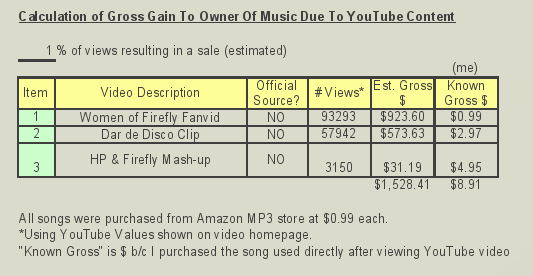
Do you have any idea how many songs I’ve purchased because I first heard them on video on YouTube?! Here’s three real-life examples:
Fanvid – Women of Firefly (using Wicked’s “Defying Gravity”)
Loved Firefly but, in addition to the craftsmanship of the fanvid, I really enjoyed the lyrics to this song. Snatched this one from the Amazon MP3 store the second I found a version by Idina Menzel.
Bollywood Video (Dar-de-disco)
Spent a weekend a couple months back just watching semi-random clips of Bollywood dance numbers on YouTube. I wrote down several songs but not all were available in the Amazon MP3 store..This one and a couple others were.
HP-Firefly Mash-up Video
Really enjoyable combo of fandoms but this video is how I discovered the awesomeness of Jonathon Coulton. Total songs bought after this vid: 5 that day.
Now, the next bit requires a bit of a leap but work with me: Imagine I’m not the only one who bought these songs after seeing these videos. Each video has a relatively large number of viewings....Let’s assume approximately 1% of those total view(er)s actually did what I did and bought the song, just the song, in the video. The below table shows that in each case, whoever owned these songs MADE MONEY because of these YouTube videos.
Other notes of importance:
(1) The videos themselves were all “unofficial” content, no one affiliated with the content owners had anything to do with creating or posting these videos.
(2) Even if my estimate of which % of viewers actually bought the songs is in question, I know that I bought every song cited (and then some) resulting total actual verifiable gross (spread to all content owners) of $8.91 MIN.
(3) While I cannot speak for any other viewers, for all of these songs, this money is a clear gain because until I watched these videos either did not know these bands or singers existed, much less that these particular songs existed, much less that I liked these songs. What these YouTube videos provided to me wasn’t a source of illegal content; what they provided was a previously missing desire to purchase these songs. If these YouTube videos did not exist, the content owners of these songs would have made $0.
Please also note, this same logic applies to books, television shows and movies for any fan-created or posted work. Again, some real-world-actually-happened-to-me examples are:
Purchasing “North & South” DVDs and Book because of clips of the BBC miniseries on YouTube
Purchasing “Leverage” Episodes via Video On Demand because of clips and trailers on YouTube
Purchasing “Life” DVDs because of clips on YouTube
In conclusion, Warner Music = MORONS because while they may be “numbers people”, like most Big Content companies and industry groups, they also don’t possess the sense (numerical or otherwise) that God gave a bag full of hammers. Please fix.
Sunday, October 26, 2008
My Civic Duty – 2008 Election Edition
Aka “Things I Did Not Know Before This Election But Discovered When Researching Candidates On My Ballot”:
1) Texas puts a crazy amount of information online! It was incredibly easy to find information on incumbents & what they had been doing. While downloading court opinions was very easy*, I would like to compliment especially the state house bill tracking system. Check this out:

I can track the progress of the bill, read supplementary reporting and if it was voted on get the voting info. For fun, I compared this to the website for my US Senator which frankly was terrible when it came to viewing his bills. First of all, getting to his sponsored bills took three screens starting with a teeny-tiny link at the bottom of his homepage. Then, the actual bill review site was very underwhelming:
In all fairness to my senator, he does have a very good history of pushing for government transparency & the like. Also the webpage for reviewing his bills appears to be handled through the Library of Congress so it maybe their faulty web design & not his. But why does his site make it so difficult to get to?
2) San Antonio’s 4th District Court is almost entirely female! And a pretty ideologically diverse and fair-minded group at that (reading the histories and opinions of the court). *is overcome with girrrrrl power glee*
3) While Texas is a lot better than some other states about at least allowing Libertarian candidates on the ballot, the local newspapers are terrible about reporting on them. Even when they mention a lib-candidate, there’s a very begrudging tone like “Oh yeah, both republican & democrat candidates suck so we’re not favoring either...and btw, whatshisname is running as a libertarian *textual giggles*”. Needless to say, this made googling libertarian candidates very annoying. I rarely found more than a name mention in any public newspaper OR on the libertarian party website listing their candidates! Newspapers I have little expectation of fairness from but when the libertarian party doesn't provide details, COME ON! I'm interested but I'm not voting for somebody I know nothing about!
4) Unique Texas practice: “the jury shuffle” – significantly less fun than the two-step. I discovered this while reading an opinion by the current Chief Justice of the Texas Supreme Court. Apparently, in Texas lawyers are allowed shuffle the seating placement of potential jurors if there are too many of one gender or one skin color(!) seated together. The only slightly-not-skeevy thing about it is that both the prosecutor or defense attorney can do it. Otherwise, this just sounds unwise.
5) Favorite phase actually used in Texas Court opinions (and quoted from precedent) – “A vain and useless thing” (translation: don’t waste the court’s precious time with BS that has no bearing on the case)
6) We have a LOT of uncontested District Judges being “reelected” in this area of Texas. The so-called candidates are from both parties. I don’t know the causes for this but I’m pretty uncomfortable with the idea of uncontested elections, even when the incumbent has done an all round good job. There’s something democratically unseemly about the false choice of an elected but unopposed candidate.
7) People in my area really enjoyed voting. There was no drama at all. Everyone was very polite and considerate and it was a very efficient process. One mother teased her son when he came out, “First time voting, just like the first day of kindergarten.” That earned her a "Mooooommm!".
* I got a little too enthusiastic about downloading court opinions and had to cut myself off. I originally intended only to download 1-2 opinions written by those justices up for re-election but…it got a little out of control. If the Texas Court System Database ever crashes, I can provide backups for a significant chunk of the published opinions in the Aug-Oct 2008 timeframe.
Friday, October 10, 2008
Dead People Voting In Droves!!!
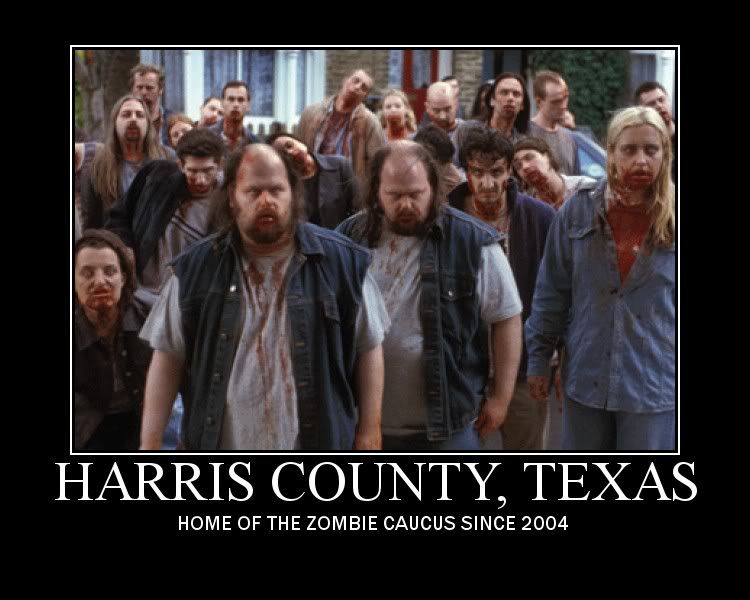
As a follow-up to this morning’s post on ACORN’s illegal election tactics, here’s this report on voter registration fraud in the Houston Area (oh no, not H-town!). From the facts in the article, these incidents don’t to have anything to do with ACORN. However, the situation does exemplify the sort of voter “irregularities” that undermine the public’s faith in elections. That’s it! I’m putting John Fund’s book on order pronto. If I’m going to be grumpy and indignant about something I might as well be grumpy, indignant and informed.
Also, I had no idea TexasWatchdog.org existed but wow, it is a really useful site. Government accountability FTW!
In light of the article, I got a little creative....
UPDATE: Darnit! I got beaten to the punch by 6 minutes over at Ace of Spades.....If only I could blog at work.
Thursday, June 26, 2008
Yet Another Comment on DC vs. Heller
Like many concerned with self-defense, I’m quite happy with today’s decision by the Supreme Court on the DC vs. Heller case. Short, short version: Yes, dear citizens, you really do have an individual right to keep & bear arms (barring some restrictions whose legal details that will be left as an exercise for the readers).
I’ll leave the legal commentary to the professionals but I would like to talk about a few structural and stylistic items which caught my eye in reading the opinion of the Court.
Overall, reading the majority & dissenting opinions was very much like watching a well-versed history professor debate two well-meaning sociology professors....In other words, a rhetorical bloodbath for the dissenters. This is most telling when you look at the length of the opinions:
Justice Scalia (Majority): 67 pages
Justice Stevens (Dissent#1): 45 pages
Justice Breyers (Dissent#2): 43 pages
Do you know the difference between opinions resulting in the longer length for Justice Scalia? CITATIONS. In great numbers and copious detail. Justice Scalia’s opinion is overflowing with them. In some parts, paragraphs consist of a couple sentences followed by 5-10 sources for an assertion. Whole pages are nothing but quotes. And his sources extend from a hundred years prior to the Founding to the present day. Seriously, the opinion reads like a history paper. A kinda awesome history paper.
Also, I don’t always agree with the man but Justice Scalia knows how to turn a phrase. A couple of my favorite zingers from his opinion:
“A purposive qualifying phrase that contradicts the word or phrase it modifies is unknown this side of the looking glass (except, apparently, in some courses on Linguistics).” -p18Or what happens when a Supreme Court Justice with a good understanding of history can knock bus-sized holes in supporting arguments from supposedly-unbiased Linguistic professionals.
“If so, they overread Miller. And their erroneous reliance upon an uncontested and virtually unreasoned case cannot nullify the reliance of millions of Americans...” -p55, footnoteThis isn’t funny by itself. However for some reason, it reminded me strongly of this "Star Wars" quote. Seriously, read this sentence aloud then listen to the quote (Start at 0:20). Hilarious I tell you. Link to full post.
Thursday, May 29, 2008
Book Review: Code v2.0 by Lawrence Lessing
Code v2.0 by Lawrence Lessig: Short, short version of review = WOW. *head explodes*
See full post for a detailed discussion of regulation in the Internet age, the political consequences of bad-code and how closed-source code has the potential to co-opt the political process.
WOW. This book is a dense and fascinating look at how the regulation of the Internet can and will reflect our larger society’s values and what that means for us as citizens. The author clearly demonstrated that modern US government has some seriously poor institutions in place for dealing with the kind of socio-legal changes in the works due to Internet regulation.
While it made for excellent reading, the holes and ambiguities latent in our current Constitutional thinking are a little terrifying. One thing that particularly striking: I have always favored a slightly stricter constructionist interpretation of the Constitution. Part of the reason for this was that loose constructionism always struck me as too “any way the wind blows”. Lessig’s discussion of translation to preserve meaning and functionality as opposed to literal preservation of exact eighteenth century thinking is the best and clearest explanation of interpretive Constitutional thought I had ever encountered. In the later parts of the book, his application of this “interpretive” Constitutional law to various aspects of free speech, privacy and political law was quite thought-provoking even in cases where I didn’t agree with his interpretation.
Not to mention Lessing has my eternal devotion for arguing for a connection I and every other engineer on the planet encounter daily. Design is rarely about absolutes; there’s usually an array of options and you choose the most feasible for your constraints (time, resources, etc). What he points out is that law is the design (“code”) of a society. There are countless assumptions and value-judgments buried into laws and regulations! The trouble comes when you make a value judgment for others (directly – smoking is illegal everywhere because its BAD; indirectly – you can’t smoke in hospitals, restaurants and bars). Most of the time the government has too much trouble regulating directly (political fallout, constitutional issues) so they choose instead to regulate indirectly. Using the example of Communist Vietnam, Lessig also points out regulatory restriction can be less onerous in situations where the government cannot enforce its regulations, resulting in the people having more freedom than you would expect because the government hasn’t the ability to make them obey.
The entire point of the book is that the Internet’s technical design (code & architecture) could give governments and private groups the ability to enforce their regulations on the people silently without their knowledge or consent. It is now possible for governments and private groups to embed their value judgments in our day-to-day lives without clearly marking these items as “law” or “regulation” and possibly without allowing for the transparency necessary to make the democratic process work. The author gives the example of a propagandist requiring all books have a chapter on Stalin (which everyone can clearly identify as indoctrination and skip) versus tweaking the text in a thousand tiny ways to propagate pro-Stalin beliefs (which would be harder for people to separate from the source and would be more difficult to identify as “regulation”).
Which leads to the standard (and wholly valid) argument in favor of open-source code. We would not accept a law written in secret, whose terms we don’t know, whose enforcement procedure details are forbidden for us to know. BUT proprietary code that embeds either governmental values (to avoid direct regulation) or commercial values (to manipulate markets/consumers) creates regulations for our lives that we aren’t allowed to know the ins&outs of. Also, it closes off debate regarding these values and the best way to propagate them. Only a select few, operating in secret, are a part of the design process.
For example, if there’s only say three companies producing code for an application and the government wants to regulate it, they can meet with the companies and build a law tailored to them. The consumer is not brought into the process until after the law is passed and the code changed. They are just served the modified application perhaps even without any notice that the new version includes a regulatory update of any kind.
BUT with open code, the builders and creators are distributed. Maybe one or two programmers design the application that regulates per government intent. However, if the consumers (&/or other programmers) don’t like it; they have the option to (1) study the regulation to improve it and (2) generate competing regulation that either propagates the values better than government intent or propagates competing values. Open code forces larger amounts of people to be a part of the distribution, design and review of code (ie – unofficial regulation of cyberspace). This functions on some levels as an increase in political participation and awareness.
If you think this is merely a thought experiment, you should review the current situation in Oregon where the state government wants to claim copyright control over the republication of state laws in order to prevent their free distribution online.
Lessig doesn’t take the easy way out either saying “ALL OPEN/CLOSED”. He provides several examples highlighting the complexity of these decisions and the fact that any “one-size-fits-all” solution is probably very, very wrong. There are certain quite legitimate reasons for secrecy. However, current thinking usually assumes secrecy is a de facto good without seriously examining if it is in fact a good in this case.
Another quite interesting point is that the very international nature of the Internet creates huge ambiguities in terms of jurisdictional boundaries. A perfect example from the book is how a streaming TV company was legal in Canada but the website was shutdown because it violated US copyright. Lessig points out that each person on-line is in essence in two locations at once: their country and the international internet community. When I use Blogspot, since I am a US citizen does US law apply to my weblog? Or international law? Or does it depend on the reader, if for example they are in China and subject to that government’s restrictions on publication and speech? For hundreds of years, geographical jurisdictions have determined the applicability of a citizen to certain laws. But with the Internet, I could run afoul of British anti-libel law, Australian hate speech laws or Chinese censorship laws. How do we determine the jurisdictional boundaries in an internet age?
In the later parts of the book, Lessig goes to great lengths to point out that solutions o this problem will need to be multi-modal and complex in order to have any functionality. There is a well-written Appendix which outlines the legal, normative, social and ????? modes by defining them and describing how they interact with one another. Although this book was published several years ago (CONFIRM), you can see the beginnings of Lessig’s recent anti-corruption advocacy here as well. He mentions several times that the current process for fund-raising is deeply flawed and demonstrates rather effectively how it nullifies the intended good of even the most dedicated elected official.
Needless to say, this is a book that gets the mental juices flowing. It’s not a difficult read; Lessing explains things like the underlying architecture of the Internet in clear non-technical terms. What makes it so provoking aren’t the questions he answers but the ones he raises. After reading this book, I’m almost tempted to conduct some kind of research into Constitutional Law because as out-dated as I thought the copyright systems was, well, it’s just a symptom of a much larger problem that isn’t going to go away soon.
So if you want something that changes the way you look at the Internet, Constitutional Law and your government, this is a highly recommended book.
Wednesday, March 26, 2008
Medellin vs. Texas
I know that I rarely speak of legal topics except for when it overlaps with the technological world. My own legal know-how is limited to “Ars Technica” articles and my “Constitutional Law” elective in college. But, the recent US Supreme Court ruling has caught my interest. The case and the resulting ruling involve many issues prominent in the current War on Terror and the increasing concerns about international laws effecting national sovereignty.
The Short, Short Version of what happened:
-Mexican citizen on Texas death row didn't get informed that he could to talk to Mexican consulate during his trial. On appeal, his defense states this renders his death sentence moot.
-Mexico went to International Court, where they said TX had to let the inmate speak to the consulate b/c of some treaty the US signed
-Texas said, "Nope, that treaty's not US law so we don't have to do any such thing."
-President Bush issued executive order saying Texas had to comply with the treaty even if it hadn't been made part of the US Federal legal code
-Texas took it to the courts....
RESULT: The Supreme Court ruled that
(1) This US treaty was not "self-ratifying" (ie - when the US signs the treaty, it becomes US law). The language was too broad to allow it.
(2) The President does not have the authority to override the above nor to command the states to follow international law not made into federal law.
After reading several articles discussing the case, the most eloquent commentary on the first part of the ruling ruling I found was at Volokh Conspiracy where Ilya Somin had this to say:
...most multilateral treaties and other international law materials are produced by highly undemocratic processes in which authoritarian states and unaccountable political elites from democratic states play a dominant role. On average, the legal rules they establish are likely to be inferior to those created by the domestic lawmaking processes of democratic states. Therefore, it is essential that international law not be allowed to override our domestic law unless it has first been "screened" by the same democratic legislative process that the latter goes through. Otherwise, courts will end up enforcing international legal rules that are likely to be systematically inferior to the domestic rules they displace.Full article.
I am a believer that elites are necessary both to lead the masses and to channel their energies more effectively. But, the best elites are those who work with and are ultimately beholden to the public. My key problem with international laws and treaties is that the elites making the decisions rarely involve people in the process. Or if they do, it’s in regard to something trivial like an online poll for naming a baby elephant on Earth Day. Too often, international bureaucrats hand down proclamations from on high without consulting anyone outside of their relatively monolithic political circles. Honestly, do you genuinely believe the US State Department (which negotiates most of the USA's treaties) is in tune with the pulse of the American public? Or they that care what the American people think? They care about what we can be convinced of, sure, but not necessarily what we want.
Therefore, the Supreme Courts ruling on self-ratification most definitely strikes me as sound. If the American public and democratic processes are in concurrence with international treaties, than the law can be ratified and enforced. Now, the opinion does include some mention that a treaty that is explicitly self-ratifying will be accepted as US law. In this case, the treaty wasn't but it could be possible. I'm not entirely happy about how the Supreme Court split that hair. I'd be much happier if we were required to vet treaties through more democratic means than the treaty negotiations process. Vetting would ensure (1) a more clearly delineated process for applying good international law-making to the United States legal code and (2) a democratic check/balance international treaties and agreements to ensure they are of good quality.
The second aspect of the ruling is both pleasing in its result and disappointing to me regarding the President’s actions. While I find him personally quite likable, the President has long since lost me when it comes to domestic counter-terrorism policies. In particular, his broad interpretations of executive powers (however well-meaning they may be) strike me as really dangerous precedents. Congress should have the authority to review treaties and create enforceable laws based on them. If there is not enough political will or public opinion to ratify the treaty or to create laws based on that treaty, then I’m sorry but the President can’t and shouldn’t just write an executive order telling states to ignore that.
President Bush's overly broad view of executive privilege is honestly one of his greatest weaknesses. The stance doesn't have near the justification his advisors think it does. I'm sure a number of government agencies do love and support this interpretation. Instead of convincing Congress (100s of people) that certain unpopular actions are necessary, they only have to convince one person. Which makes it disturbingly easy to get things done. What Mr. Bush and many of his advisors fail to realize is that people are kinda put off by government when its too effective especially when it comes to investigative and prosecution powers. The President's failure to understand that and pick his battles has resulted in many people being put off by his continued requests for less executive oversight. Yes, terrorism is a real problem but it's also not a blanket justification for destroying checks on executive privilege. That the Supreme Court struck down this broad interpretation is encouraging.
Taken together these two aspects of the ruling (limited self-ratification and limit on executive privilege) ensure that the United States can participate in the international legal process while still staying (somewhat) true to its Constitutional roots. The ruling clearly supposes that international law has a valid place in the US legal system while also ensuring checks and balances are maintained. It's a compromise but an effective one.
Recently, there are issues cropping up in Constitutional law that more frequently highlight inconsistencies in our Constitution. That document was created based on the assumptions of 18th century men. For the most part, those assumptions have lasted and remain valid. But with new technologies and more global integration on all levels, some inconsistencies that previously didn’t affect anything are becoming important, even critical to the continued good governance of this country. I can only hope as these issues work through the court system, the Supreme Court’s further rulings in resolving these situations are as well considered as Medellin vs Texas. Link to full post.
Monday, January 28, 2008
Book Review: The Hacker Crackdown
The Hacker Crackdown by Bruce Sterling focuses on the 1990 dragnet by federal, state and local police forces to reign in the "digital undergroud". This is the sweep that led to the founding of the Electronic Freedom Foundation. It is a funny, interesting and unflinchingly fair book.
The cops in this book are for the most part, well-intentioned. The best of them share techno-mania and love of computers with their intended targets, the hackers. And the hackers themselves are a remarkably weird bunch. I mean, most hackers of the sort portrayed in this work are, well, losers. The only people who are shown as almost uniformly negative are the telecommunications corporations and their employees. It’s not the negativity of muckraker, merely of someone observing a culture both out-of-date and wildly bureaucratic. The book ends by focusing on the real heroes, the techno-libertarians.
The founders of the EFF aren’t good guys because they were “sticking it to the man”, they were (and very much are) good guys because they keep the cops honest. And, in reading about the trial of hacker “Knight Lightening”, the cops really need to be watched closely. Not because they are bad people intent of robbing us of our freedoms but rather, because our technological advances are creating large ambiguities in the legal system of this country. Ambiguities cops have to navigate and hope they don’t get caught on the wrong side of. The EFF are dedicated to forcing discussion of those ambiguities and possibly resolving them sometimes in order to help law enforcement do its job better.
I highly recommend this for those interested in the history of computers and digital freedoms.
Thursday, November 8, 2007
WGA Strike
As you may guess from the icon in the right-hand column, I'm doing something wildly out-of-character for me: I'm supporting a union during a strike. Specifically, the Writer's Guild of America against the studios. The guys from "The Office" explain it way better than I ever could:
For more info:
United Hollywood
(For fan-side) WGA Supporters on LiveJournal
My contribution:
-No viewing of streaming videos on ANY network site or any download service
-Once the LiveJournal guys post a form letter, both studios & advertisers will be getting letters from me
-I will not be viewing ANY of the replacement shows. I will watch the remaining episodes of my shows that were made before the strike BUT not the ones made after the showrunners went on strike. All replacement shows are OFF. This will include "Project Runway: Season 4" (sigh).
Tuesday, November 6, 2007
TED Talk by Larry Lessig
Once again, the TED talks provide an opportunity for a great thinker to spread their ideas. In addition, I want to know where he found his example videos....Larry Lessig on the Read-Write Culture (I tried to embed the videos but it gave me errors...sorry).
PS - This is what the third TED lecture I've linked? If you're not checking out these talks, I think you're missing out on the cutting edge of modern thought.
Monday, October 29, 2007
Monday Miscellany
1) Gene Therapy Reduces Death Due To Radiation in Mice. Since it’s looking less and less likely that we’ll be able to stop nuclear proliferation, this means if some nut job does try to set off a bomb we’ll be able to do something proactive to minimize the effect of the fall-out. Good news.
2) So, last week Comet 17P/Holmes got enormously brighter. No one’s really sure why...Although, many people have their eyes on the sky and there are theories. The link also contains some fantastic pictures showing the scale of the event and links to photos from all over the planet. Several people at work have been sky-watching to get a glimpse.
3) 5 Scientific Reasons A Zombie Apocalypse Could Happen. I have a sudden desire to take up camping and stock up on “boom-sticks”. I particularly like this quote:
Scientists have already created a nano-cyborg, by fusing a tiny silicone chip to a virus. The first thing they found out is these cyborgs can still operate for up to a month after the death of the host. Notice how nano scientists went right for zombification, even at this early stage. They know where the horror is.
4) 5 Ways Environmentalists Can Be Less Annoying. "There are some people that, for whatever reason, you can agree with completely about political, environmental, or social issues, but still just want to hit in the face repeatedly." Hallelujah! My personal favorite is number four - "Read A Book [on statistics]". Oh thank you. Poor understanding of the science is one of my long pet-peeves with die-hard environmentalists.....I had some poor experiences in college. Have you ever tried explaining the intricacies and fallibility of climate modeling to Spanish majors? (shudder)
5) THIS MAKES ME FURIOUS. Not only is ComCast “shaping traffic” by interfering with and cutting off P2P traffic (including the wholly legal LotusNotes), they are instructing their service representatives to LIE about it to their customers. WHAT PUNKS. It sounds like their employees aren’t really happy about the situation either. Why else would so many of them be risking their jobs to rat out the company? Hopefully, someone will hit upper management with a clue-by-four soon. More information here and here. Link to full post.
Monday, October 1, 2007
Monday Hit List
I haven’t done a hit list in a while. Blogging may be minimal for rest of the week due to travel.
1) 10 Ways the World Could End (and what we can actually do about it). Yet another awesome talk from TED. This lecture while scary, does point out that for the first time in human history we have the ability to really do something about these potential catastrophes.
2) Radiohead Distributing Music Without Record Label. They are distributing directly through their website on a “pay-what-you-think-its-worth” basis. Very cool idea. I feel the sudden urge to buy an album.
3) Excerpts from a 1943 Guide to Handling Female Employees. Back then = 100% serious. Now = 100% funny. My favorite:
3. General experience indicates that "husky" girls - those who are just a little on the heavy side - are more even-tempered and efficient than their underweight sisters.
4) How To Install MoBlock. It’s a program that prevents someone else from tracking your online activities. Very cool and handy considering the “information-gathering” tactics used by the RIAA and MPAA nowadays.
5) Six Dead From Brain Eating Amoeba. I do not remember who said it but “Never underestimate the ability of reality to outweird fiction.” I’m suddenly really glad I didn’t go tubing on any Texas rivers this summer.
6) Texas Lawmakers Violating The Law! THIS IS UNACCEPTABLE. One of the offenders is a woman pushing for a law requiring photo IDs to vote. Talk about not practicing what she preaches! I intend to write my State Legislator a very stern letter. For Texans, here’s a list of state legislators in case you don’t know who yours is. Link to full post.
Friday, September 14, 2007
Friday Miscellaneous
I haven’t done one of these all week...
1) Scientists Invent Non-Stick Chewing Gum. Because they have nothing better to do. Although, maybe they’re counting on the money saved from not cleaning streets to go toward more research? Tricksy scientists.
2) User Generated Health Info. A very good article on consumer-generated health info, it’s quality and how the Internet is spurring on this activity. Interesting and somewhat useful.
3) Excellent article on the bogus claims of organic foods. With the amount of false assertions floating around about organic and genetically modified crops, it’s good to read an article written by somebody SANE.
4) Fair Use Worth More than Copyright Use. Consumer use of copyrighted content generated more wealth for the economy than use by the copyright holders. Remember THAT next time someone tells you DRM is a good idea.
5) The More Unusual Articles on Wikipedia. No comment just a good time waster.
Friday, September 7, 2007
Friday Hit List
1) Much Needed Patent Reform Act. Currently in-process in Congress. Looks like a much more civil discussion then the equally-necessary copyright reform.
2) HILARIOUS op-ed on recent financial troubles in the lending markets. Don't lend money to people who can't pay it back? What a concept. The best quote of the piece:
But as I say, it was my fault, for not studying the poor more closely before I lent them the money. When the only time you've ever seen a lion is in his cage in the zoo, you start thinking of him as a pet cat. You forget that he wants to eat you.
3) Katana Sword vs. 9mm. The world would be such a crappy place without Japanese television.
4) Enable Insults in Ubuntu Command Line. Make typo, suffer the consequences. Link to full post.
Friday, August 17, 2007
Digitial Music Files
I have spent every spare minute this week converting wmas to mp3s in preparation for my permanent Ubuntu install. As part of this I’ve discovered a few things:
1) WMA files are huge! Mp3 conversion has freed up a good bit of my HD and I’m only a few hundred songs in.
2) I’ve decided there’s no way in hell I’m paying Napster $275 dollars MIN to keep “my” god-damn-DRM protected songs. I’ve saved a list of them and I’ll be re-acquiring these tunes elsewhere.
3) Windows has the exact same problem as Ubuntu for ripping CDs to mp3s. I attempted to rip a recently bought CD with Windows Media Player and got a similar error message to my SoundJuicer attempt “Mp3 codex unavailable”. Ubuntu’s correction to rip & play mp3s requires an install via Synaptic (which I haven’t completed yet). Windows method is to charge you $10 for the MP3 ripping ability or this "helpful" page from Microsoft.
4) This is not so much a discovery as a realization and a decision. Explained beneath the cut.
At UT-Engineering, the lectures for your senior design project are about general ideas in engineering that could effect product development. During the discussion of intellectual property, my professor emphasized several times software should be patentable and copyright protected because it should be treated the same way as concrete goods. I didn’t & don’t really have a problem with that.
BUT, current software licensing acts in a way totally counter or acceptable for concrete goods. EULA’s get around the end user loophole in commercial law. Meaning no matter how much you paid for any piece of software under an EULA, it’s NEVER your property. Consider a situation where you have purchased* a car, computer or television, etc. Now imagine GM, Dell or Sony telling their customers “After one year your purchase of this product is revoked.” And in order to regain “your” property, you have to pay for your goods twice, thrice or more. Concrete goods are not treated in this manner (see First Sale Doctrine).
DRM-protected music files are no better than EULAs. As the recent Google Video fiasco proves, no matter what you paid for digital media, it’s never yours. This flies in the face of any reasonable expectation of ownership. If I own a CD when buying it in a bricks-and-mortar store, then I also should own a CD purchased in an on-line store. PERIOD. If the entertainment companies want to keep up this DRM BS, then they should be forced to change their services' descriptions from "Purchases" to “Rent to Use”. This of course will never happen because apparently the very last thing big entertainment wants is to be honest with their customers.
As of now, I don’t plan to ever use a DRM-protected music store again. And I don;t have to with places like eMusic and AudioLunchbox.
* not rent or lease, that is a transaction defined as different from the get-go
Wednesday, August 1, 2007
Computer Smorgasbord
FCC complaint against overly broad copyright claims. It looks like NBC, Universal, MLB and the NFL have been vastly overstated their copyrights in order to scare consumers. And they’re getting called on it.
30+ Firefox add-ons. Most of them involve picture, pdf or video downloading. Several look interesting for me to tweak Firefox.
10 Things Your IT Dept Won't Tell You. 10 ways around draconian corporate internet controls. While I applaud the attempt, I can verify one of these doesn’t work. I attempted to use a proxy site today at work and my company, cleverly, blocks them.
Tuesday, July 24, 2007
Tuesday Miscellaneous
1) NBC is making ridiculous claims to the FCC in order to stifle P2P technologies. I find it so amazing big entertainment companies make such colossal PR blunders. If they want to know why revenue and sales are down, it’s because people don’t want to be hassled with poorly-functioning copyright control software. If NBC succeeds they will be nailing their own coffin shut for when Internet-distributed TV serials hit the big time.
And lists like this one make it easier for users to generate their own content instead of being dependent on big media. There's over 400 tools for multi-media blogging there. I just flipped through them but really cool. I have a feeling I will be spending some time here in the near future.
2) Two weblogs of Interest:
Ars Technica creates Open-Ended, a web journal on Open-Source software. Looks promising.
Life Hacker: Weblog provides a variety of tips on everything from time management to computing to how to slice a watermelon. So book-marking this one.
3) Possible liquid water in the Kuiper Belt. The more I read about our Outer Solar System, the more excited I get about the upcoming New Horizons Mission.

 Posts


